
Going Pains

In 2001, millennial pop star Britney Spears sang that she was “not a girl, not yet a woman”. In other words, she was an adolescent. Actually, she was 20 at the time—no longer a teenager, but well below the age at which our frontal lobes stop developing. With your team, explore the history of teenagers and the related terms below. If adolescence has always been a developmental stage in both humans and many other animals, why is the idea of teenagers so new?
The idea that the brain, particularly the frontal lobe, stops developing at 25 is a pervasive misconception in psychology and neuroscience. Like many myths, the “age 25” idea is rooted in real scientific findings, but it’s an oversimplification of a much longer and more complex process. In reality, new research suggests this development actually extends into our 30s. This new understanding changes how we view adulthood and suggests that 25 was never meant to be the finish line in the first place.

Researchers have discovered that there are four major topological turning points across the lifespan – around nine, 32, 66, and 83 years old. These ages defined five major epochs of topological development, each with distinctive age-related changes in topology. Some interesting facts include how a typically developing infant’s brain network displays adult-like structure with hub distribution, rich clubs, small-worldness, and modularity at birth. Throughout early development, networks become more integrated with increasing strength and efficiency and decreasing modularity. In adulthood, many researchers describe an inverted “U” shape of development with a peak occurring around 30 years old where the brain is maximally efficient and integrated.
Humans have been turning 13 for tens of thousands of years, but only recently did it occur to anybody that the bridge between childhood and adulthood deserved its own name. The term teen-ager dates back to the early 1900s, but the word didn’t stick. Even until World War II, there are hardly any instances of teenagers in the popular press. By the end of the 20th century, if most ancient cultures were gerontocratic, ruled by the old, modern culture is fully teenocratic, governed by the tastes of young people, with old fogies forever playing catch-up. The teenager emerged in the middle of the 20th century thanks to the confluence of three trends in education, economics, and technology. High schools gave young people a place to build a separate culture outside the watchful eye of family. Rapid growth gave them income, either earned or taken from their parents. Cars (and, later, another mobile technology) gave them independence.

1. The rise of compulsory education
As the U.S. economy shifted from a more localized agrarian society to a mass-production machine, families relocated closer to cities, and — at least initially — many sent their children to work in the factories. This triggered a countermovement to prevent kids from being forced to toil in mills. Between 1920 and 1936, the share of teenagers in high school more than doubled, from about 30 percent to more than 60 percent. As young people spent more time in school, they developed their own customs in an environment away from work and family, where they could enforce their own social rules.


2. The postwar economic boom
The 1950s saw one of the great periods of economic expansion in American history. With full employment came rising wages for unionized adults and older teenage workers. Meanwhile, parents gradually had fewer children and spent more per child, as befits any scarce and valuable investment. Birth rates declined across the advanced world in the second half of the 20th century due to both the rise of female education and the legalization of the pill. Since the 1970s, the richest 20% of U.S. households have more than doubled their spending on childhood “enrichment,” such as summer camps, sports, and academic competitions.
3. The invention of the car
It might be a horrifying consideration for today’s singles, but a first date once meant an introductory chat in the living room with a girl’s parents. This might have been followed by a deliciously awkward family dinner. But cars emancipated romance once and for all and spawned a high school subculture. “The abolition of child labor and the lengthening span of formal education have given us a huge leisure class of the young, with animal energies never absorbed by tasks of production,” wrote one New York Times critic in 1957. Even in the early years of their classification, teenagers were regarded as cultural nomads. Rather than settle into the established rituals of American society, they were roving vagabonds seeking out new frontiers of tastes and behavior.
As soon as teenagers were invented, they were feared. Many social critics made no distinction between the young car-jacking thieves and the comic readers. The last 60 years have made teenagers separate. But are they really so different? Or are teens just like adults — but with less money, fewer responsibilities, and no mortgage?
Teenagers are chemically distinct from the rest of humanity. They suffer uniquely from loosely connected frontal lobes, the decision center of the brain, and an enlarged nucleus accumbens, the pleasure center. So where adults tend to see the downsides of risky behavior in high definition, teenagers see the potential rewards as if projected onto an IMAX screen with surround sound. The result is sadly predictable: Teens take more risks and suffer more accidents. Americans between 15 and 19 have a mortality rate that’s about three times higher than those ages 5 to 14.


For Laurence Steinberg, a career investigating the teenage mind started with a common observation: Teenagers often act dumber around other teenagers. Teens are driven by the desire to be cool. Adults drove the same, whether or not they had an audience. But teenagers took twice as many “chances” — like running a yellow light — when their friends were watching. Teenagers are exquisitely sensitive to the influence of their peers. What used to drive teens in the 90s such as fashion logos are now replaced by mobile phones and social media influence. Teenagers are the market’s neophiles, the group most likely to accept a new musical sound, a new clothing fashion, or a new technology trend.
Research has shown that many non-human species also have a period of intense learning and development between childhood and full adulthood. According to UC Berkeley professor of psychology and neuroscience Linda Wilbrecht, “When you look across the animal kingdom at different adolescent animals fledging from the nest, leaving burrows, you see what a heroic journey these animals are on,” she said. “It really takes your

breath away to start thinking about the power of adolescence and what the brain must be going through to take on all of these new experiences and to learn so much at this time.” New experiences and trial-and-error learning are key features of this post-juvenile period in many species.
Linda explained that animals need to disperse–to leave their relatives, packs, and the places where they were born–to avoid inbreeding, and this often happens during adolescence. This may require long distance travel, trying out new places, and exposure to predators. These adolescents need to explore their new environments to learn when and how to find food and water. And even once they settle down, new social challenges are sure to arise.
Adolescents may even have a special “instinct to learn”—a term used by the great biologist Peter Marler to describe development in songbirds. Linda explained this learning process. Adolescent songbirds will sit near singing adults and listen intently to their songs. Over the weeks (and sometimes months) they pick and choose whose song they want to imitate. They then go through multiple and sometimes messy stages of practice, until at last they create their own perfected song. Often the learning of the adolescent period involves taking risks. In her book Wildhood, Barbara Natterson-Horowitz describes how adolescent sea otters, often in groups, dart into the territory of great white sharks. This risky group behavior may look crazy, but is likely an adaptive process that helps adolescents learn about the patterns of predators so that they can survive as adults.
How has the lexicon "teenager" been portrayed since its advent? Some of the earliest mentions of the word ‘teenager’ in the British Newspaper Archive are in relation to fashion.
Teenage Triumphs
In 1945, The Sketch features several outfits under the title ‘Teen-age Triumphs.’ There is a ‘playtime sweater,’ and a ‘young-looking and very smart’ dress available for teenager readers.
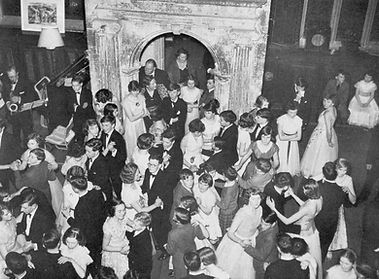

What Turns a Teenager Into a Terror?
This enthusiastic celebration of youth seems to fade from our newspaper pages as we roll into the next decade, the 1950s. We begin to see much more stereotypical and familiar representations of the teenager as difficult, grouchy, and generally problematic. Parents wanted to know what happened to cause this change into a moody and sulky teenager. In February 1955, one Mrs G of Leamington is writing to Mary Brown’s agony aunt column in the Daily Mirror, desperate to understand what it is that ‘turns a teenager into a terror:’
My son, who was fourteen a month ago, used to be reasonably obedient and straightforward. He confided in me and we were best of friends. This last year he’s been steadily changing. He’s cheeky and he’s sulky…Why should a boy change like this? Do you think he’s got into bad company? I’m so worried in case he becomes one of the ‘delinquents’ we read so much about.

What Should a Teenager Be?
There were many in the 1950s who believed that teenagers were quite simply ‘delinquents,’ or at least engaged in upsetting the status quo in some other less dramatic way – staying out late attending dance halls, or watching the latest rock and roll movies (Bill Haley’s Rock Around the Clock caused a sensation when it was released in 1956, and it was banned in many cinemas).
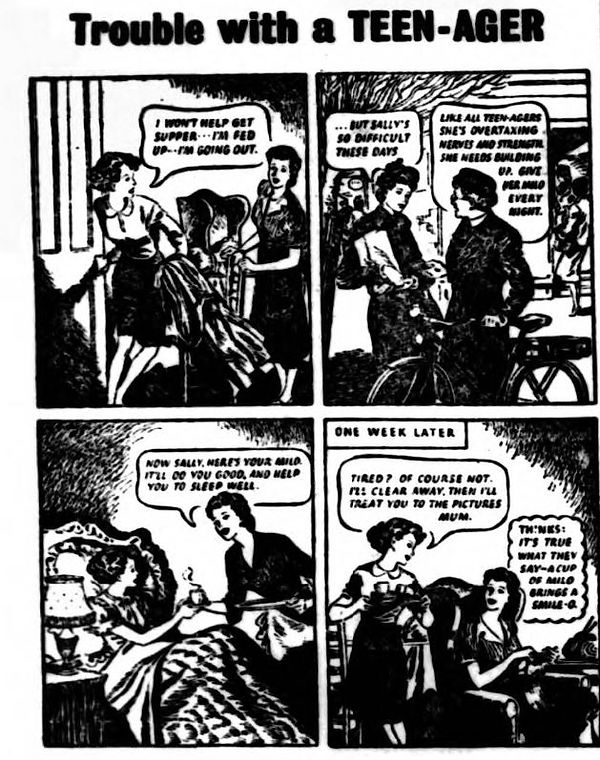
They Grow Up So Much Earlier
And if adults of the age were busy wondering what a teenager should be like, they were also worrying whether or not they were just growing up too soon. They worried that they dressed too maturely, as girls picked out dresses for formal dances at school.

Aren’t Our Girls a Mess?
But still, caught betwixt and between youth and adulthood, teenagers (and this complaint seems disproportionately levied at girls in The Archive) were still seen as scruffy and untidy. In a 1954 article entitled ‘Teenagers Need Not Look Untidy‘ for The Tatler, Jean Cleland describes how teenage girls’ hair ‘often looks awful.’

In 1966, Tatler’s Angela Ince describes teenage girls as a ‘mess’ – ‘taking pains to look their worst.’
Why do they clump around in Granny shoes? Why do they wear tiny freezing skirts that stop short at the most unflattering length ever devised? … Her hair is either dead straight and long as she can get it, or as though designed by Pythagoras, curtly short and geometric. It surrounds a face that could have just walked out of a mortuary, chalk-white, pale-lipped, and with eyes cunningly made up to look as though they’ve been in a brawl.
prefrontal cortex
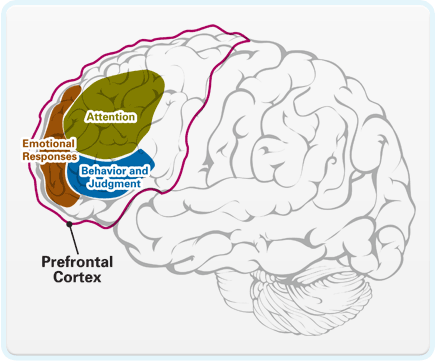
The prefrontal cortex, responsible for planning, decision-making, and self-control, is one of the last brain regions to fully mature, continuing development into the mid-20s. The prefrontal cortex (PFC), located at the front of the brain behind the forehead, governs executive functions such as planning, prioritizing, working memory, inhibitory control, and cognitive flexibility. These functions allow teens to manage thoughts and actions toward goals, anticipate consequences, and adapt behavior to changing situations. Because the PFC is still developing during adolescence, teens often display impulsivity, risk-taking, and difficulty with long-term planning.
Biological Processes of PFC Development
During adolescence, the PFC undergoes two major biological processes:
-
Synaptic pruning: The brain eliminates underused neural connections while strengthening frequently used ones, improving efficiency and refining cognitive circuits.
-
Myelination: Nerve fibers are insulated with myelin, which increases the speed and efficiency of electrical signal transmission across brain pathways.
These processes contribute to a prolonged maturation timeline, making the PFC one of the last regions to reach full maturity, typically around age 25.


neural pruning
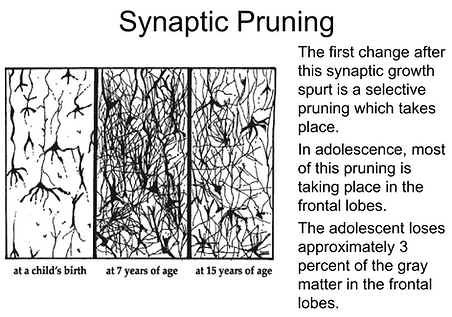
During adolescence, the brain undergoes synaptic pruning, a process that eliminates unused neural connections to improve efficiency, particularly in the prefrontal cortex, shaping cognition, behavior, and mental health.
Neural pruning, or synaptic pruning, is the selective elimination of synapses—the connections between neurons—that are underused or unnecessary. This process streamlines neural networks, making the brain more efficient and specialized for complex cognitive tasks. It operates on a “use it or lose it” principle: frequently active synapses are strengthened, while rarely used ones are removed. Microglia, the brain’s immune cells, help engulf these weaker synapses, guided by molecular signals that tag them for elimination.
Timing and Adolescent Brain Development: While pruning begins in early childhood, adolescence is a critical period for this process. During the teenage years, the brain undergoes extensive reorganization, particularly in the prefrontal cortex, which governs executive functions such as planning, decision-making, impulse control, and emotional regulation. Up to 40% of synaptic connections in certain regions may be pruned during this stage, optimizing neural efficiency and reducing “noise” in brain signaling. This remodeling coincides with myelination, which enhances the speed and coordination of neural communication.


Functional Implications: Synaptic pruning allows the adolescent brain to specialize and adapt to environmental demands. It supports improved cognitive processing, abstract thinking, and social cognition. Engaging in learning, music, sports, or other skill-building activities during adolescence can help retain useful neural circuits, while underused pathways are eliminated. This process is essential for transitioning from the broad potential of childhood to the specialized capabilities of adulthood.
Links to Mental Health: Disruptions in pruning—either excessive or insufficient—can affect how brain regions communicate, particularly in the frontal lobes, and are associated with mental health disorders such as depression, anxiety, ADHD, schizophrenia, and autism spectrum disorders
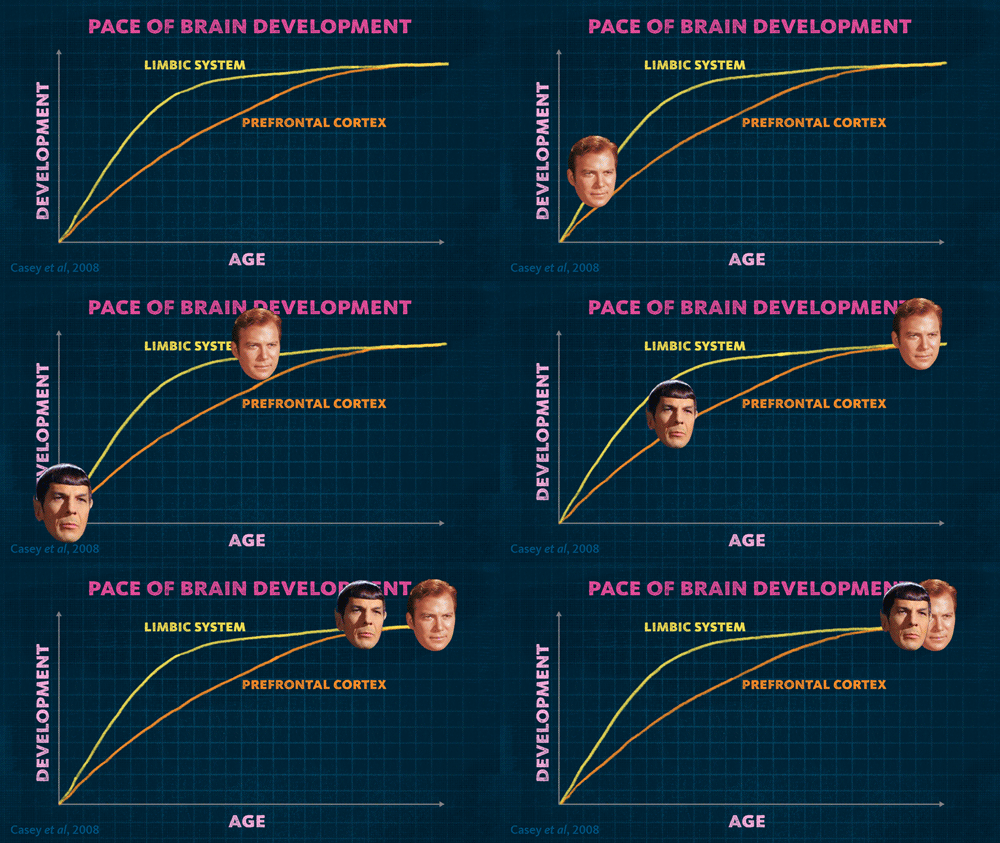
Adolescent risk-taking is a normal and developmentally significant phase shaped by biological, social, and emotional changes, not simply poor judgment. The brain's socio-emotional reward center develops faster than the cognitive control regions. Neuroscience shows that during adolescence, the reward system (limbic system, nucleus accumbens) matures earlier than the cognitive control system (prefrontal cortex). This creates a “developmental gap” where the brain’s drive toward exciting, novel, and emotionally charged experiences is strong, while impulse control and long-term planning are still developing. This developmental gap creates heightened sensation-seeking and vulnerability to peer influence.
-
The Reward System: The limbic system (specifically the ventral striatum) matures first. This area drives the seeking of rewards, dopamine, and pleasure. In adolescence, this system becomes highly sensitive, particularly in the presence of peers.
-
The Control Center: The prefrontal cortex—the part of the brain responsible for executive function, impulse control, and long-term planning—is the last to mature. It does not reach full adult connectivity until well into a person's twenties.
-
Dopamine sensitivity peaks in early to mid-adolescence, making rewarding experiences feel more intense than in childhood or adulthood.
-
The prefrontal cortex undergoes prolonged synaptic pruning and myelination, improving gradually until the mid-20s.
risk-taking


Neophilia
Neophile or Neophiliac, a term popularised by author Robert Anton Wilson, is a personality type characterized by a strong affinity for novelty.
Neophilia in teenagers is the natural tendency to seek out new experiences, ideas, and stimuli, often driving curiosity, exploration, and risk-taking behaviors. Neophilia is a personality trait characterized by a strong attraction to novelty and a desire to engage with new experiences, ideas, or environments. In teenagers, this trait is particularly pronounced due to developmental changes in the brain, including heightened sensitivity in regions like the thalamic pulvinar, which is associated with novelty-seeking behavior. Adolescents with high neophilia often display curiosity, creativity, and a willingness to experiment with new foods, activities, or social experiences.
There is more than one type of neophile. There are social neophiles (the extreme social butterfly), intellectual neophiles (the revolutionary philosopher and the technophile), and physical/kinetic neophiles (the extreme sports enthusiast). These tendencies are not mutually exclusive, and might exist simultaneously in the same individual.
Differentiation
In psychology and neuroscience, differentiation refers to a system becoming more specialized, complex, and distinct. During adolescence, this process happens simultaneously across a teenager's psychological identity and their physical brain architecture. It represents the literal transition from a dependent child to an autonomous, highly specialized adult.
Self-Concept Differentiation: Teenagers move away from describing themselves in flat, broad terms (e.g., "I am nice"). They begin to develop contextual, nuanced understandings of their own identity (e.g., "I am outgoing with my friends, but quiet and reserved around teachers").
Individuation: This is the process of psychological separation from parents. Adolescents establish unique values, beliefs, and boundaries, allowing them to form an independent identity while remaining connected to the family unit.
Emotion Differentiation: This is the ability to pinpoint and label specific emotional states. Instead of feeling broadly "bad," a highly differentiated adolescent can distinguish whether they are feeling anxious, jealous, lonely, or guilty. Studies indicate this capacity can fluctuate during the chaotic middle-school years but stabilizes as a tool for mental health by late adolescence.
The word “adolescent” comes from a Latin word meaning “to grow toward”. But “teenager” relies on a quirk of the English language—that the numbers 11 and 12 have their own unique words, while 13 through 19 are compound words that combine a single-digit number and a suffix meaning “ten” (four-teen, six-teen, and so on). How do other languages refer to adolescents and teenagers—and does your own first language differentiate between these two terms? What are their different connotations? Do cultures with languages that use a -ten suffix for the numbers 11 and 12 define the “teenage” years differently? For instance, in Spanish, the -ten suffix only comes into play at 16—diez (10) y seis (6); do children only become teenagers at 16 in Spanish-speaking countries?
Linguistic structure directly alters how these cultures conceptually group and define youth. In English, the concept of a "teenager" is an arbitrary semantic construct born out of the -teen suffix, which only spans ages 13 to 19. However, in languages where the equivalent numeric suffix or prefix covers ages 11 and 12, the cultural boundary of this life stage expands. The most prominent examples of this phenomenon occur in Slavic languages and Hungarian.
In Slavic languages like Polish, Russian, and Ukrainian, the suffix for numbers 11 through 19 is derived from an old phrase meaning "on top of ten" (e.g., jeden-naście in Polish or odin-nadtsat in Russian). Because 11 (jede-naście) and 12 (dwu-naście) include this suffix, an 11-year-old is literally and legally considered a nastolatek. While a 11-year-old in the U.S. is categorized firmly as a "tween" or child, Slavic cultures linguistically anchor 11- and 12-year-olds into the same broader developmental bucket as 17-year-olds. Marketing, school groupings, and social expectations for independence shift slightly earlier because they are viewed as having entered the "transitional age" (perehodnoy vozrast in Russian). A 10-year-old Hungarian is linguistically grouped with a 19-year-old. This structure aligns clean numeric decades with social identity, completely skipping the American concept of a "pre-teen" or "tween".
Many cultures hold special ceremonies to celebrate the passage from the dependency of childhood to the responsibilities of adulthood. With your team, explore the following rites of passage and consider: what is the difference between a cultural rite, such as a quinceañera, and a secular one, like graduating from high school?
Sweet sixteens

A sweet sixteen is a coming-of-age party celebrating one's 16th birthday, mainly celebrated in the United States and Canada. While they are not a legal adult, typically, when they turn 16 is when many people learn to drive, get jobs, and assume other adult responsibilities. For many, the 16th birthday celebrates adulthood and marks the end of a childhood. As the name suggests, the celebration takes place on a sixteenth birthday and is celebrated among girls and boys, though it is typically more common with girls. In the past, sweet sixteens tended to be formal, whereas they tend to be more informal today.
For girls, the shoe ceremony is common at sweet sixteen parties. In this ceremony, the birthday girl sits in a chair while her father, grandfather, godfather, uncle, or brother approaches her, carrying a decorative pillow with high heels. The girl traditionally wore flat shoes, such as slippers, and the male family member ceremoniously helped her into her new high heels. This is symbolic of the girl transitioning into a woman.
The tiara ceremony is similar to the shoe ceremony, except the mother or a strong female figure approaches with a tiara instead of shoes and places it on her daughter's head to symbolize her becoming a woman. Sometimes, this is combined with the shoe ceremony so that two people approach the birthday girl, one with a pillow with high heels and the other with a pillow with a tiara.
While also performed at Bar and bat mitzvahs and Quinceañeras, this ceremony is common for Sweet Sixteen celebrations. There are typically 16 candles, each given to special family members and friends by the birthday girl. Usually, when the recipient of the candle is named, the birthday girl says a few words in regards to why this person (or people) is special to them, they may tell a short story or fun memory they have shared with that person. The birthday girl can decide to give her candles to whomever she chooses.
.jpg)
Quinceañera
A Quinceañera in the United States, is a coming of age celebration in Latin American cultures for a girl's 15th birthday. Contemporary festivities combine Catholic traditions from old Spain with the traditions of indigenous heritages of pre-Columbian Mexico, along with a few modern twists. For example, in ancient Mexico, the Aztecs and other indigenous peoples had many different ceremonies to mark the passage through the various stages of life. The quinceañera marked a young woman's transition to adulthood, as she was presented, as a virgin, to the community for probable suitors. Other origin stories attribute quinceañera history to the Duchess of Alba in Spain, who hosted a ball at her palace and invited adolescent girls to attend in formal clothes. In a traditional Mexican quinceañera, young women and men have roles as formal damas and chambelanes, who perform special bends at the celebration, along with the quinceañera herself. There is also a "man of honor" who accompanies the young woman. Potential suitors present gifts to her family to make up a dowry or bridal wealth. Prior to her being given away, the women of the community participate by instructing the quinceañera in her duties and responsibilities, urging her to follow the correct path, by remaining true to her people and their traditions throughout her life.
In the 1960s, as more Latinos migrated to the United States, they brought their differing national traditions with them. Once in the United States, formerly poor immigrants with good jobs were able to have big parties such as those back in their home country. Now, in the US, it is considered a status symbol and Latino families, who spend upwards of $10k. In the United States, a typical quinceañera in 2025 costs between $8,000 and $25,000, with most families spending in the $15,000–$21,000 range
.jpg)

.jpg)

vision quest
A vision quest is a rite of passage in some Native American cultures. Individual Indigenous cultures have their own names for their rites of passage. Among Native American cultures who have this type of rite, it usually consists of a series of ceremonies led by elders and supported by the young person’s community. The process includes a complete fast for four days and nights, alone at a sacred site in nature which is chosen by elders for this purpose. Some communities have used the same sites for many generations. During this time, the young person prays and cries out to the spirits that they may have a vision, one that will help them find their purpose in life, their role in a community, and how they may best serve the People. Dreams or visions may involve natural symbolism – such as animals or forces of nature – that require interpretation by elders. The Vision Quest is not merely a test of endurance; it is a spiritual journey aimed at self-discovery, humility, and connection to the natural and spiritual world.
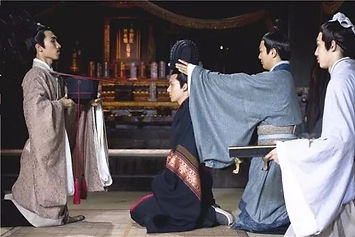

Guan Li
The Guan Li (simplified Chinese: 冠礼) is the Confucian coming of age ceremony. According to the Li Ji (lit. 'Book of Rites'), it is only after the coming of age ceremonies that young people could call themselves adults and could share social responsibilities. Both the Guan Li and Ji Li have important symbolic meaning for the Han Chinese. Both of these ceremonies are key Confucian rites, and are part of the "four rites", along with marriage, mourning rites, and sacrificial rituals.
The standard age of guan li is when a young man turned 20 years old and when a woman reaches 15. The ceremony takes place in the young man's ancestral temple on a carefully chosen date, which was considered auspicious, and it was organized by a respectable senior relative of the young man. The youth received a formal cap (guan), marking adulthood. It signified that the man could now marry, hold office, and participate in ancestral rituals. Women celebrated Ji li (笄礼) at age 15, receiving a hair pin. The candidate received three different caps representing social responsibilities. The young man received a "Courtesy Name" (zi) to be used by peers. The adult man paid respects to his ancestors and parents to show gratitude. Following the Confucian tradition, Koreans also performed the "capping" ceremony, known as Gwallye.
Seijin no Hi
Coming of Age Day (成人の日, Seijin no Hi) is a public holiday in Japan held annually on the second Monday of January under the Happy Monday System. It is held in order to congratulate and encourage all those who have already reached the age of maturity between April 2 of the previous year and April 1 of the current year, and to help them realise that they have become adults. Festivities include coming of age

__'Minister_Narihira%E2%80%99s_Coming_of_Age%2C'_Japan%2C_Edo_period.jpg)
ceremonies (成人式, seijin-shiki) held at local and prefectural offices, as well as after-parties among family and friends. On June 13, 2018, the age of maturity was lowered for the first time since it was established. According to the new law, which came into force in 2022, a citizen is considered an adult with the onset of full 18 years. Note that Coming of Age Day and the ceremony itself are not directly linked to changes in the legal status of young people. For example, adult status becomes effective on the 18th birthday, with some exceptions; both men and women can marry and are released from parental authority.
Rituals to celebrate adulthood have existed since ancient times, such as genpuku (changing to adult clothing) and fundoshi-iwai (loincloth celebration) for boys, and mogi (dressing up) and keppatsu (tying the hair up) for girls. Cultural anthropology and folklore studies treat such ceremonies as rites of passage (initiations).
Today's form of the Japanese Coming of Age Ceremony has roots from the Youth Festival held in Warabi Town (currently Warabi City), Kitaadachi County, Saitama Prefecture on November 22, 1946, shortly after Japan's defeat in World War II. At the time, when Japan was in a state of despair due to the defeat, Shojiro Takahashi, then the leader of the Youth League of Warabi Town (later the mayor of Warabi City), hosted a youth festival in order to give hope and encouragement to the young people who would bear Japan's future.
Bar and Bat Mitzvahs
A bar mitzvah (masc.) or bat mitzvah (fem.) is a coming of age ritual in Judaism. According to Jewish law, before children reach a certain age, the parents are responsible for their child's actions. Once Jewish children reach that age, they are said to "become" b'nai mitzvah, at which point they begin to be held accountable for their own actions. Traditionally, the father of a bar or bat mitzvah offers thanks to God that he is no longer punished for his child's sins. In Orthodox communities, boys become bar mitzvah at 13 and girls become bat mitzvah at 12. In most Reform, Reconstructionist, and Conservative communities, the milestone is 13 regardless of gender. After this point, children are also held responsible for knowing Jewish ritual law,
tradition, and ethics, and are able to participate in all areas of Jewish community life to the same extent as adults. In some Jewish communities, men's and women's roles differ in certain respects. For example, in Orthodox Judaism, once a boy turns 13, it is permitted to count him for the purpose of determining whether there is a prayer quorum, and he may lead prayer and other religious services in the family and the community.
The Bible does not explicitly specify the age of 13. Passages in the books of Exodus and Numbers note the age of majority for army service as twenty. Machzor Vitri notes that Genesis 34:25 refers to Levi as a "man", when a


calculation from other verses suggests that Levi was aged 13 at the time. The term "bar mitzvah" appears first in the Talmud, meaning "one who is subject to the law", though it does not refer to age. The term "bar mitzvah", in reference to age, cannot be clearly traced earlier than the 14th century, the older rabbinical term being "gadol" (adult) or "bar 'onshin" (one legally responsible for own misdoings).
Many congregations require pre-bar mitzvah children to attend a minimum number of Shabbat prayer services at the synagogue, study at a Hebrew school, take on a charity or community service project and maintain membership in good standing with the synagogue. In addition to study and preparation offered through the synagogue and Hebrew schools, bar mitzvah tutors may be hired to prepare the child through the study of Hebrew, Torah cantillation and basic Jewish concepts.
Walkabout
A walkabout is a spiritual and cultural journey undertaken by adolescent Aboriginal males, typically between the ages of 10 and 16, marking the transition from childhood to adulthood. During this period, the young person lives alone in the bush, surviving off the land, following ancestral paths known as songlines, and learning essential survival and cultural skills such as finding water, identifying edible plants, making fire, and building shelter. The journey is both physical and spiritual, connecting the individual to the Dreaming—the complex system of

beliefs, stories, and laws that explain creation and guide life. Elders decide when a young person is ready and provide guidance and instruction beforehand, ensuring they are prepared for the challenges of the walkabout. Walkabout is not merely a journey; it is a sacred practice of becoming, a way to step into responsibility, adulthood, and cultural knowledge. It reinforces the lore, songlines, and ancestral stories, ensuring that cultural traditions are passed down through generations. Participants may also be marked with body paint, ornaments, or symbolic modifications to signify their initiation.
Khatam al-Qur’an means “the completion of the Qur’an” — reading all 114 chapters (Surahs) from beginning to end, starting with Surah al-Fatiha and ending with Surah an-Nas. The Arabic word khatam means “seal” or “to bring to a close,” symbolizing the moment you’ve finished the Book of Allah.
The Prophet Muhammad said, “Whoever recites a letter from the Book of Allah will receive one good deed, and each good deed is multiplied by ten”. This means every letter you read is a blessing. After finishing, many Muslims make a Dua Khatam al-Qur’an — a heartfelt prayer thanking Allah and asking for His mercy, forgiveness, and guidance.
Khatam al-Quran


debuts
A debutante, from French: débutante , 'female beginner', or deb is a young woman of aristocratic or upper-class family background who has reached maturity and is presented to society at a formal "debut" or debutante ball. Originally, the term indicated that the woman was old enough to be married, and one purpose of her "coming out" was to display her to eligible bachelors and their families with a view to marriage within a select circle. A debutante ball, sometimes called a coming-out party, is a formal ball that includes presenting debutantes during the social season, usually during the spring or summer. Debutante balls may require prior instruction in social etiquette and appropriate morals.

There are some notable debutante balls in Europe and the US. Le Bal des Débutantes remains one of Paris’s most iconic social events, blending centuries-old tradition with modern glamour, and attracting the world’s most famous young heiresses and heiresses-to-be. "“Le Bal” is a diplomatic event of sorts. The Debs and cavaliers and their families bring together movers and shakers from cultures and walks of life around the globe. “ It is also known as the “Met Gala for teenagers” and the “nepo baby” ball in the media.

high school graduation
High school graduation represents one of life’s most significant milestones – a moment that marks the end of one chapter and the beginning of another. After years of studying, tests, and countless hours in classrooms, students finally reach this pivotal celebration that transforms them from high school students into graduates ready to take on the world. High school graduation ceremonies, also known as commencement exercises, serve multiple important purposes beyond simply handing out diplomas. These formal celebrations represent a rite of passage that has deep cultural and educational significance in American society.
The ceremony typically begins with the academic processional, one of the most visually striking elements of graduation day. This formal parade features school personnel, board members, and sometimes distinguished guests walking into the venue to music provided by the school band. The traditional musical selection is often “Pomp and Circumstance,” a ceremonial march that has become synonymous with graduation ceremonies. The heart of most graduation ceremonies includes several types of speeches. The valedictorian, typically the student with the highest academic achievement, delivers a speech reflecting on the shared high school experience and looking toward the future. The salutatorian, usually the second-highest achieving student, may also speak. Additionally, a student representative chosen by their peers often addresses the graduating class.
The actual diploma presentation involves several traditional elements. Students typically shake hands with the principal or superintendent, receive their diploma (or a diploma cover with the actual diploma distributed later), and pose for an official photograph. This moment is often accompanied by applause from the audience and represents the formal recognition.


The graduation cap and gown are the most recognizable symbols of academic achievement. The cap, known as a mortarboard, features a flat square top with a tassel that traditionally hangs on the right side before graduation and is moved to the left side after receiving the diploma. The gown’s design has remained relatively unchanged for centuries and represents the academic tradition that connects modern graduates to scholars throughout history. The famous cap toss at the end of the ceremony originated at the U.S. Naval Academy, where graduating midshipmen threw their caps into the air upon receiving their new officer hats. The tradition spread to civilian schools and now represents the joyful celebration of achievement and the symbolic release of the student phase of life.
driver’s license
For past generations, turning 16 symbolized freedom.
If you were of the Baby Boomers (1946–1964), Generation X (1965–1980), or Millennials (1981–1996), your 16th birthday more than likely involved you pulling out of your parent’s driveway in a car for the very first time! For teens a driver’s license meant independence, mobility, and the unofficial start of adulthood. But in 2026, the landscape looks entirely different. America is experiencing a dramatic shift in the average age for getting a driver’s license.
1. Driving Anxiety and Fear of Doing Something Wrong
Some studies show this likelihood for today's teen's to feel anxiety and depression is over 80% higher, and this anxiety can spill over into learning how to drive.
2. Less Motivation to Drive Due to Social Media
Gen Z spends a significant amount of time online, with estimates ranging from over 6-8 hours per day on average, with a large portion of that time dedicated to social media. Many events are being held via Zoom over the internet, creating a culture where there is less motivation to get a driver’s license.
3. Rise of Ride-Share and Delivery Culture
With apps to order food to your door, or a ride from point A to point B, it can seem pointless to go through the process of learning to drive due to the new rise in convenience technology.


first paycheck
Receiving your first paycheck is a major milestone in the transition from adolescence to adulthood, marking the shift from relying on family support to managing your own income and financial responsibilities. It is the beginning of understanding financial independence, paying taxes, and saving for the future.
In many Asian cultures, it is when a young person starts contributing financially to his family, by giving part of his/her salary to the parents. In the United States, many teens begin working to learn about responsibility and also earn spending money.

-
Statista indicates that in 2021, the percentage of employed teenagers aged 16 to 19 while enrolled in school in the United States rose was 19.4%.
-
According to the online recruitment firm, Zippia, teens between the ages of 16 and 19 work an average of 25 hours per week.
-
As of the writing of this article, Zip Recruiter indicates that the average teen income is $2,727 a month.
-
Historically the BLS has observed significant growth in teen employment between the months of April and July, as high school and college students seek summer employment.
national service
A National Service Coming-of-Age Ceremony is a formal, often community- or nation-wide event that marks a young person’s transition from childhood to adulthood, integrating them into the adult role within their society. Conscription is mandatory national service. The term national service comes from the United Kingdom's National Service (Armed Forces) Act 1939. In many cultures, it is both a personal milestone and a public affirmation of readiness for civic, social, and sometimes military responsibilities.
National services customarily includes:
-
A military or civic oath.
-
Feature training demonstrations or service commitments.
-
Be held at military bases, community centers, or national landmarks.
-
Involve leadership training, civic education, and service projects alongside the formal rite.
There are around 85 countries worldwide that have some form of obligatory military training, including Turkey, Cyprus, Israel, Syria, Brazil, South and North Korea. Military service is compulsory in South Korea. All men between the ages of 18 to 36 have to undergo military training.


voting
A legal voting age is the minimum age that a person is allowed to vote in a democratic process. Most nations use 18 years of age as their voting age, but for other countries their voting age ranges between 16 and 21 (with the sole exception of the United Arab Emirates where the voting age is 25). A nation's voting age may therefore coincide with the country's age of majority, but in many cases the two are not tied.
No matter where one votes, age is always critical for determining eligibility. For a long time, 21 was considered the standard minimum age required to vote. But just after World War II, Czechoslovakia became the first country to lower the age limit to 18. Many other countries soon followed suit. The United States enacted the same standard in 1971. The impetus was the “old enough to fight, old enough to vote” campaign during the Vietnam War, which was based on the belief that if people are old enough to be in the military, they should be allowed to have a say in the government that commands that military.

moving out
Leaving your parents home is a major milestone in a course of life and carries both cultural and personal weight. In Asia and parts of Europe, moving out is a ritual of modernity and independence. It signals the adult is ready to have his or her own household or will no longer contribute on a daily basis to his or her parents' household. In Asia many families are multi-generational, so it is less expected for adult children to move out. It varies widely between regions. For example in Northern Europe, the average age to leave home is around the mid-20s, while in Southern Europe and Balkans, it is over 30 years old.

However, in America and western countries, it is seen as a historical rite of passage at around age 18. While there are quite a lot of movies and cultural joke about "failures to launch", many people are choosing to stay with their parents for longer than expected. This is especially evident during the pandemic with economic instability and lock-downs. During the recession the average age is also older as more people live with their parents to save on costs.
A ceremony offers a definite moment: now you are a man, or woman, or more broadly an adult. But the transition to adulthood is rarely a single, clean step; more often, it is a series of stumbles. The following works explore the messy middle years, where childhood collides with the expectations of tradition, society, and self-identity. As you explore them, consider: is adulthood a destination you reach or a mask you learn to wear?
Gwendolyn Brooks | “We Real Cool” (1963)
When is rebellion justified? What are the costs of the teenage fast-life? “We Real Cool” paints an image of black, rebellious teenagers and their short-termist life style. The poem is short, and can be interpreted both as supportive of this lifestyle and critical of it. The teenagers know that they will “die soon”, and live life to its fullest YOLO, and yet this line coming at the end of the poem suggests that their rebellion hastens their death. Though the speakers' race is unspecified, the poem is widely understood as addressing the limited futures faced by young Black men navigating systemic prejudice and economic disenfranchisement.
The poem presents seven young pool players at the Golden Shovel pool hall who speak collectively about their lives. The eight-line poem consists of four rhyming couplets, with "We" appearing at the end of most lines, creating a jazz-like rhythm. The speakers boast about their rebellious lifestyle: they have left school, lurk late at night, strike straight (likely referring to both pool and confrontation), sing sin, thin gin (water down their alcohol), and jazz June (rebelling against the establishment represented by the month of June). The poem concludes with the stark, shocking admission: "We / Die soon". The subtitle establishes the scene: "The Pool Players. / Seven at the Golden Shovel," with the "golden shovel" metaphorically suggesting both treasure-seeking and grave-digging.

Virginia Driving Hawk Sneve | “The Medicine Bag” (1975)
This is a powerful story about culture and tradition, reminiscent of the cliche of the chinese kid afraid of bringing dumplings to school because they would be made fun of, and decides to bring a PB&J instead. The story revolves around the relationship a teenager named Martin has with his Sioux-Indian grandpa. Martin is Native-American-white, and though he is proud of his fantastical Sioux heritage in the form of warrior stories and other tales of the Plains, he is ashamed of his grandfather who is frail and old, unlike the image of a bold warrior that Martin thinks his friends have of his grandfather.
Over their childhood, Martin and his sister Cheryl, loved bragging to their city friends about their Sioux grandfather, Joe Iron Shell. They enjoyed talking about his life on the Rosebud Reservation, often exaggerating his image to match the "TV Indian" stereotype. However, they hid his real photo, fearing to be humiliated by their friends because he is nothing like the tall, stately figures in the movies.

One day, 86-year-old Grandpa unexpectedly travels alone for two and a half days by bus to visit them, exhausted and suffering from heat exhaustion. Martin feels ashamed and embarrassed at first, worried that his friends will mock Grandpa’s old-fashioned appearance and simple life, but he soon feels proud of Grandpa’s courage to make the long trip alone. Grandpa brings savings hidden in his boots for his funeral, refusing to be a burden for the family.
Grandpa then reveals his real purpose of the trip: to pass down the medicine bag—a sacred Sioux family heirloom—to Martin, the oldest male child. The bag holds a piece of iron kettle, a pebble, and sacred sage, linked to their ancestor Iron Shell’s vision quest and family history of preserving Sioux traditions. Martin initially dislikes the idea of accepting the bag, fearing his friends’ teasing, but he grows to respect its meaning.
When Martin’s friends finally meet Grandpa, they are deeply impressed by his stories and dignity, making Martin proud. Grandpa formally gives Martin the medicine bag, telling him to keep it safe and add prairie sage when he returns to the reservation, passing the tradition to the next generation. Later, Martin goes back to the reservation alone and places the sacred sage in the medicine bag, honoring his Sioux heritage.
Not only does this piece of work tells the heart-moving story of the tradition of the medicine bag, but it also gives an example of a definite moment: where Martin becomes a man, and receives the medicine bag. However, he still needs to return to the reservation to complete the ceremony, or as mentioned in the WSC curriculum, the “series of stumbles” required for the transition to adulthood. This beat-up cultural artefact containing mementos of his ancestors. Martin goes through an emotional arc of being embarrassed of wearing the bag around his neck and having it become a part of his identity, to accepting the artefact as the continuation of his grandfather’s memory. The Medicine Bag arouses a question as provided in the curriculum: is adulthood a destination you reach or a mask you learn to wear?
Carol Ann Duffy | “In Mrs. Tilscher’s Class” (1990)
Carol Ann Duffy's poem "In Mrs. Tilscher's Class" (1990) is a nostalgic yet unsentimental look at childhood, capturing the magic and security of a beloved primary school classroom while subtly tracing the pivotal, and often unsettling, transition into adolescence. Its significance lies in how it perfectly depicts this journey from innocence to experience, contrasting the protected world of a child with the complex realities of growing up.

The poem opens in a world of wonder. The child is spellbound by Mrs. Tilscher’s lessons, like tracing the "Blue Nile" on a map, and finds joy in simple classroom rituals. The classroom is a place of security, described as "better than home" and "glowed like a sweet shop". Mrs. Tilscher is central to this environment. Her love makes the children feel valued, celebrated by a "gold star by your name". Progressing through the school year, the poem changes tones; come over the Easter term, as the children's growth is mirrored by the classroom's tadpoles that "changed from commas into exclamation marks" and the teacher "smiled, then turned away," signaling you have to find your own answers.
Many may look back to their childhoods and think of sunny classrooms and perfect days in the school-yard, wishing that they could stay in those moments forever. Duffy intersperses traumatic events that accelerate maturity among the happy memories In Mrs. Tilscher’s Class, creating an uneasy tone: the killers Brady and Hindley (shockingly inhumane Bonnie and Clyde crime duo), learning about how your parents created you. By the end of the poem summer comes and the July air “tasted of electricity”. Impatient to leave this classroom-Eden you rush out of the school gates to find that the sky “split open into a thunderstorm”, suggesting that the transition from childhood to adulthood is unpredictable and tumultuous. The poem powerfully shows that this safe and pure childhood spae, while beautiful, cannot last forever.
Joss Whedon | “Where Do We Go From Here?” (2001)
"Once More, with Feeling" is the seventh episode of the sixth season of the American supernatural drama television series Buffy the Vampire Slayer (1997–2003), and the only one in the series that is a musical. It was written and directed by series creator Joss Whedon and originally aired on UPN in the United States on November 6, 2001.
"Once More, with Feeling" explores changes in the relationships of the main characters, using the plot device that a demon—credited as "Sweet" but unnamed in the episode—compels the people of Sunnydale to break into song at random moments to express hidden truths. The musical format allowed characters to stay true to their natures while they struggled to overcome deceit and miscommunication, fitting with the sixth season's themes of growing up and facing difficulties in adulthood.

The episode nears the end with "Where Do We Go from Here?", as the Scoobies stand dazed and disoriented, facing different directions. The central theme is the uncertainty that follows. They ask, "Where do we go from here? Why is the path unclear?". A key line, "Understand we'll go hand in hand, but we'll walk alone in fear," highlights their fractured unity. Whedon's use of "literal choreography" in "Where Do We Go from Here?" expresses the anxiety of the characters in relation to the group after they have all divulged their secrets. Interestingly, For its 65th anniversary in 2018, TV Guide picked their 65 best television episodes of the 21st century, ranking "Once More, with Feeling" fifth. In 2021, Los Angeles Times called it the best musical episode ever made.
Karen Russell | “Lucy's Home for Girls Raised by Wolves” (2006)
The story is about how hard it is to change who you really are to fit into a new world. The narrator, a wolf girl named Claudette succeeds in becoming human, but it comes at a cost: she loses her connection to her wild past and her little sister.
A group of girls who grew up in the forest with wolves arrive at St. Lucy's. Claudette and her pack of sisters, raised by wolves in the wild, are sent by their parents to St. Lucy's, a convent school run by nuns. They are wild and confused. They act like animals: they pee on the beds to mark their territory, chew on things, and don't understand human words. The nuns who run the school are surprised by how wild they are, but they give them human names and try to be patient. Then, they tried to fit in, even though life at the school is hard. The girls have to learn boring human rules, like not licking each other's wounds and eating strange food like peas and soup.

The girls' progress is guided by The Jesuit Handbook on Lycanthropic Culture Shock, which describes their journey through five stages of assimilation. Claudette is a determined student, striving to master human customs like walking upright, speaking, and learning etiquette. Her older sister, Jeanette, adapts quickly and becomes a model student, resented by the pack for betraying her origins. In contrast, Claudette's younger sister, Mirabella, struggles deeply and cannot give up her wolf-like behaviors, such as loping on all fours. She can't learn the rules, she acts out, and she gets sicker and sadder. Claudette realizes that to survive, she has to stop acting like a wolf and stop helping her sister, because being with her sister makes herself wild
As the girls progress, they internalize human values and begin to ostracize Mirabella for her failure to adapt. Claudette is torn between her new identity and her old life, feeling like a "spy" or "double agent" in human society. The story culminates with a Debutante Ball celebrating the girls' successful transformation. The narrator is dancing with a boy named Kyle and pretending to enjoy the party. However, when the bright spotlight hits her, she panics. All the human stuff she learned disappears for a moment, and she feels like a scared animal again, losing control of her body. In the end, Mirabella, unable to be "civilized," is expelled from St. Lucy's, and her sisters know they will likely never see her again.
This story reminds me Canada’s residential school program, a government‑sponsored system of boarding schools for Indigenous children — First Nations, Inuit, and Métis — established from the 19th century until the late 1990s. It was created to assimilate Indigenous peoples into Euro‑Canadian culture by removing children from their families, languages, and traditions.
Ruth B | “Lost Boy” (2015)
Ruth B.'s "Lost Boy" is a piano ballad that uses the familiar story of Peter Pan to explore universal themes of loneliness, belonging, and the power of imagination as a refuge. The song, which became a viral hit after the artist shared a six-second snippet on Vine, is intentionally crafted to be open to many different personal interpretations.
The song traces a narrator's journey from profound loneliness to a sense of belonging. The opening verses establish a deep isolation: "There was a time when I was alone / Nowhere to go and no place to call home" . The narrator's only companion was the distant and sometimes absent "man in the moon," underscoring a feeling of being utterly disconnected.
The song speaks to the universal human need to escape from a painful or unwelcoming reality. Peter Pan and Neverland symbolize finding a "passion or purpose" that brings comfort and a sense of home when life gets tough. For Ruth B. herself, this "Neverland" was her piano and songwriting.
The song resonates because it captures the profound pain of feeling like an outsider with nowhere to go . The journey to Neverland represents the deep human desire to be accepted and to find a "family"


Major Jackson | “Let Me Begin Again” (2021)
Major Jackson’s poem “Let Me Begin Again” (2021) is a powerful and vibrant call for personal and spiritual renewal. It’s a plea to start over, defined by a sense of urgent possibility and joy, even as it acknowledges present crises. As a starting point, Jackson has stated that the poem was influenced by "global health, political and climate crises". The poem, then, is not just a personal meditation but a direct response to a world in distress, seeking renewal in the face of these overwhelming challenges. This is powerfully illustrated in the lines addressed to the "Dear Leopards disintegrating / at the outer limits of our greed".
The poem begins with the speaker wishing to "begin again" and envisions a new start rooted in a childhood moment of pure wonder, seen through the eyes of "a brown child on a beach at dawn straining to see their future". This image of quiet contemplation and potential sets the tone for the journey ahead. As the poem unfolds, the speaker wants to discard old, trivial concerns and vanities, like "old music in the pines" and "sifters of scotch," to make way for a more authentic existence. The goal is to confront fear directly by circling the "island of my fears only once," and then to live with vibrant, unrestrained energy—to "live like a raging waterfall" and with a touch of whimsy, "grow a magnificent mustache".
The poem is also significant in its formal inspiration. Jackson wrote it as a tribute to Philip Levine's poem of the same title. In essence, "Let Me Begin Again" is a poem about the necessity of choosing hope, action, and connection, even when the world feels broken. It urges us to shed our vanities, face our fears, and embrace the chaotic, beautiful, and uncertain business of living with our eyes wide open.
Millennials—people born between about 1981 and 1995—gave us side parts, skinny jeans, and “adulting”. This term transformed adulthood into a verb, something you do (often with great effort) rather than something you simply are. Whether going to bed early, scheduling a dentist appointment, or buying a vacuum cleaner, describing your actions as “adulting” implies you are just role-playing as a grown-up. Consider with your team: is being an adult a specific feeling or just a collection of habits and responsibilities? When do you think you will feel like an adult?
The verb form of the word "adult" became popular around 2016 and this newly invented word describes 1. to behave in an adult manner; engage in activities associated with adulthood and 2. to make someone behave like an adult; turn someone into an adult. According to Jane Solomon, a lexicographer at Dictionary.com and one of the article’s authors, a big factor is millennials and their “delayed development”. “This generation of millennials,” she says, “they go through life stages that other generations have gone through much later in life, like starting families, owning homes. Maybe they won’t own homes at all.” The age of first-time mothers is indeed at a historic high of 26.
And so this jokey way of describing one’s engagement in adult behaviors—whether that is doing your own taxes, buying your first lawn mower, staying in on a Friday, being someone’s boss or getting super pumped about home appliances—can help those millennials acknowledge and/or make fun of and/or come to grips with that transition (or how late they are to it).
Depending on the person and their listeners, different motivations may be driving the “adulting” utterance. It may be the speaker’s insecurity at so rarely finding themselves in an adult posture well into their 30s. Or it may be their wish to imply that they’re still so young and hip that it is laughable for them to be, say, ironing the serviettes before a dinner party. Or it may be their fear that their peers will find the fact that they spent a lot of time doing "adult things“ like home economics, like baking and gardening.
Linguist and author Ben Zimmer, another mind behind the American Speech article. Adulting tends to be used by those “who find themselves doing adult things for the first time and feeling like an adult,” he says. “It is very much attached to people coming of age, where they’re thrust into having to take things more seriously.” Every generation, he adds, “comes to grip with aging in their own way.”
Life is a journey—but does it end with a final port of call or a temporary layover? Explore the following works and discuss with your team: how do they handle the idea of life approaching its last liminal moment?
Rumi | “A stone I died” (c. 13th century)
This poem implies that life is a cycle, or reincarnations that from a stone to a plant to an animal and finally a man. The process of death does not make a person any less but adds meaning to the cycle of life. Each person is a progression to the next level of life. This philosophy is consistent with many religions including Hinduism, Buddhism, Jainism, and Sikhism.

John Donne | “Death Be not Proud” (1633)
Also known as Holy Sonnet X, this is one of the most famous poems in the English language. The poem's primary significance is its audacious attempt to strip Death of its power through sheer intellectual and spiritual force. Donne rejects the passive fear of mortality and instead confronts it head-on, using logic and faith to argue that Death is not an end but a gateway.
The poem is structured as a direct address to Death, which the speaker personifies. The opening line, "Death be not proud, though some have called thee / Mighty and dreadful, for thou art not so," immediately establishes the poem's central argument: Death is not the fearsome force it claims to be.
The speaker systematically dismantles Death's power by arguing that it is merely a "rest and sleep," which are pleasurable experiences. From this, the speaker reasons that Death must provide even greater pleasure. The poem then argues that Death is not a sovereign power but a servant to external forces like "fate, chance, kings, and desperate men," and that it dwells in "poison, war, and sickness."
The speaker further diminishes Death by comparing it to "poppy or charms," which can induce sleep just as effectively. The poem then engages with Christian theology, arguing that death is not the end but a transition: "One short sleep past, we wake eternally." This is a direct reference to the resurrection of the body and the promise of eternal life. The final, triumphant couplet delivers the ultimate blow: "And death shall be no more; Death, thou shalt die." This paradox—that Death itself will be defeated and cease to exist—is the climax of the poem's argument.


Written shortly after the death of Tennyson's close friend Arthur Henry Hallam, the poem is a dramatic monologue spoken by the legendary Greek hero Ulysses (Odysseus) in his old age. It is a stirring meditation on restlessness, the hunger for experience, and the refusal to succumb to a quiet, sedentary life.
The poem opens with Ulysses, now an old king, expressing his profound discontent with his domestic life in Ithaca. He finds the "still hearth" and the "barren crags" of his kingdom tedious and unfulfilling. He describes his people as "savage" and "hoard, and sleep, and feed," and he feels his role as a ruler is to "mete and dole / Unequal laws" to a populace that does not know him. He dismisses his wife, Penelope, as aging and his son, Telemachus, as better suited to the "common duties" of ruling.
Ulysses yearns for the adventurous life of his past. He recalls his travels and the "delight of battle" and feels that he has not yet exhausted his capacity for experience. He declares, "I am a part of all that I have met," and emphasizes that all experience is an "arch wherethrough / Gleams that untravelled world, whose margin fades / For ever and for ever when I move."
Despite his old age, Ulysses refuses to surrender to passivity. He acknowledges that "death closes all" but argues that even in old age, "some work of noble note, may yet be done." He contrasts his own restless spirit with the "indolent" existence of his fellow elders. The poem builds to a powerful climax as Ulysses, addressing his old mariners, calls them to join him on one last voyage. He famously declares: "To strive, to seek, to find, and not to yield."
The poem ends on this note of defiant determination, as Ulysses and his crew, though old, resolve to sail "beyond the sunset" and embrace whatever fate awaits them.
The poem captures the restless energy of the Victorian era. The 19th century was a time of immense scientific, industrial, and geographical exploration, and Ulysses's desire to "follow knowledge like a sinking star" and to seek the "untravelled world" resonated deeply with Victorian readers. The poem embodies the Victorian ideal of progress, the belief that humanity must always strive forward, never resting on its accomplishments. Its final line, "To strive, to seek, to find, and not to yield," has been used as a motto for explorers, athletes, and anyone facing adversity, and celebrates humanity's indomitable spirit.
Alfred Lord Tennyson | “Ulysses” (1842)


Emily Dickinson | “Because I could not stop for Death” (1890)
Dickinson is one of the most imaginative poets who lived a strange life of solitude, never leaving the house, due to a strange illness. Yet, her world was full of deep thoughts, keen observations of nature and a unique exploration of humanity. Written around 1863 and published posthumously in 1890 (many of her poems were letters to her sister-in-law), the poem offers a unique and unsettling meditation on mortality. Rather than depicting Death as a terrifying or violent force, Dickinson personifies Death as a courteous, patient suitor who gently guides the speaker toward eternity.
The poem opens with the speaker’s famous admission: “Because I could not stop for Death – / He kindly stopped for me –.” The speaker is too busy with life to think about death, so Death takes the initiative, arriving in a carriage that also carries “Immortality.” This sets the scene for a slow, peaceful journey. The carriage ride is described as a leisurely outing. They pass by familiar sights: a school where children are playing (“the Ring”), fields of “Gazing Grain,” and the “Setting Sun.” These images represent the stages of life—childhood, maturity, and old age. As they continue, the speaker notes that they pass the setting sun, suggesting a movement beyond the realm of the living and into the afterlife.
The journey becomes increasingly cold, as the speaker is inadequately dressed for the chill. They pass a “House” that seems to be a grave, described as “a Swelling of the Ground.” This is the speaker’s own tomb. The poem then shifts to a reflection on the passage of time. The speaker realizes that the journey, which felt like a single day, has actually taken “Centuries” and feels “shorter than the Day” because the horses’ heads are “toward Eternity.” The poem ends with the speaker in a state of peaceful eternity, having completed the journey from life to death.
The most significant aspect of the poem is its personification of Death. Dickinson subverts centuries of tradition that depicted Death as a grim reaper or a terrifying monster. Instead, Death is “kindly,” “civility,” and patient. He is a suitor who “kindly stopped” for the speaker, suggesting a gentle and inevitable transition rather than a violent end. This portrayal transforms death from a subject of fear into a natural, almost welcome, part of existence.
The image of Death as a suitor who “kindly stopped” for the speaker can be seen as a critique of the traditional marriage plot, where women are expected to passively accept the proposals of men. The speaker’s surrender to Death’s carriage ride may symbolize the societal pressure on women to submit to patriarchal authority. However, the poem also suggests a form of agency, as the speaker chooses to enter the carriage and embrace her fate.

Rabindranath Tagore (1861–1941) was a Bengali poet, writer, playwright, composer, philosopher, social reformer, and painter who reshaped Bengali literature and music in the late 19th and early 20th centuries. Tagore's international fame came with the English translation of his poetry collection Gitanjali (Song Offerings), published in 1912 . This work won him the Nobel Prize in Literature in 1913, making him the first non-European and the first lyricist to receive this honor.
The poem is a deeply personal and philosophical reflection on the mysteries of existence. It is structured as a first-person meditation that moves through three key moments: birth, life, and death. The speaker begins by acknowledging the unconsciousness of birth: "I was not aware of the moment when / I first crossed the threshold of this life." This establishes a sense of wonder about the forces that brought the speaker into being. The speaker compares this emergence to a "bud in the forest at midnight," an image of quiet, natural, and mysterious unfolding.
Upon encountering the world, the speaker feels an immediate sense of belonging. The "inscrutable without name and form" – the divine, formless mystery of the universe – is experienced through the tangible, intimate form of the speaker's own mother. This is a profound statement of faith: the unknown divine is made known and accessible through human love.
The speaker extends this logic to death. The "same unknown" that welcomed the speaker into life will appear "as ever known" at the moment of death. Because the speaker loves life, they trust that they will also "love death as well." Death is thus transformed from a terrifying end into a familiar, loving transition. The poem concludes with a striking metaphor: a child who cries when taken from the mother's right breast only to find consolation in the left one. This image suggests that the separation of death is momentary and that comfort is immediate and certain.
Rabindranath Tagore | “Gitanjali 95” (1913)
Dmitri Shostakovich | 15th Symphony: Fourth Movement (1972)
Dmitri Shostakovich was a Soviet-era Russian composer and pianist who became internationally known after the premiere of his First Symphony in 1926 and thereafter was regarded as a major composer. The Symphony No. 15 in A major, Op. 141, composed between late 1970 and July 29, 1971, is his final symphony. The second movement begins with a brass chorale, followed by a cello solo. These themes alternate with a funeral march introduced by a pair of solo flutes, then taken up by a solo trombone. The finale contains several musical quotations, starting with the "fate motif" from Götterdämmerung, followed by the opening motif from Tristan und Isolde. At the end of the symphony, the percussion creates a relentless ticking, seeming to illustrate a lifetime. The final note on the celesta provides a sense of inconclusion, and on the cycle that life is.


Thich Nhat Hanh | “Please Call Me by My True Names” (1976)


Zen Master Thích Nhất Hạnh is a global spiritual leader, poet, and peace activist, revered around the world for his pioneering teachings on mindfulness, global ethics, and peace. Born in Vietnam in 1926, he became a Zen Buddhist monk at the age of sixteen. This poem explains how even if death was approaching, we are constantly “arriving.” Thích Nhất Hạnh uses metaphor to explain the cycle of life and how he is part of it all. He is the mayfly and the bird that eats the mayfly, he is the frog and the snake, he is the refugee and part of the politburo, he is the rape victim and the pirate. No matter the prey or the predator, within nature or society, Thích Nhất Hạnh refers to it as “his true name,” demonstrating that to accept all of these identities is to “open the doors of compassion.” he ultimate goal is to "wake up" and "see that my joy and pain are one."
David Berman | “A Letter from Isaac Asimov to his Wife Janet, Written on His Deathbed” (1999)
Not actually written by Isaac Asimov, David Berman, a musician and poet, theorizes what Isaac Asimov might have thought during his last moments within is collection Actual Air. The poem, written in the form of a letter, finds Asimov in his final moments, reflecting on his life and creative work. He revisits the genesis of his stories, recalling how a novel came to him while studying an egg tray, and mentions his own creations like "robot nymphs" and his desire to escape Earth, “away from the chain letters, fever, rats, and unemployment..”
The poem's Asimov also touches on his identity as a Jew and his struggle with the concept of hidden truths, a theme that feels personal and private . The scene shifts to his sickroom. The world outside intrudes; he references a "weather forecast" and a lingering "jealousy" of the living, which he fears will kill him before the night is out . He wonders about his final legacy, imagining an intern at his publishing house, Doubleday, asking: "What were his last ten thousand words..."
Instead, he decides to dwell in the present, spending his dying moments envisioning the cardinals as “quarts of blood”, the housefly, the characters of his books, and of “A Neptune indiscernable from Vermont.”

Linkin Park | “In the End” (2000)
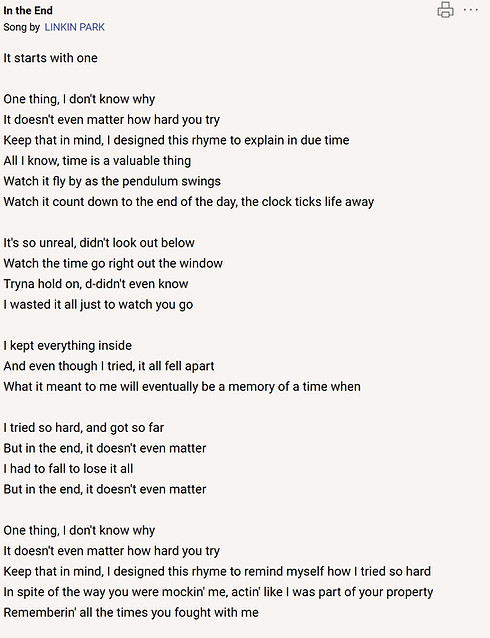

"In the End" is Linkin Park's signature song and a defining anthem of the early 2000s. While a personal take on failure, its universal theme of putting everything into something only to see it fall apart has allowed it to resonate with a global audience for decades. The song was originally written as a poem by vocalist Chester Bennington and was almost left off the album because he initially disliked it, a decision he later admitted he was "wrong" about. The song explores the frustration of investing everything into a relationship, a personal goal, or a dream, only to find the outcome is out of your control and the effort feels meaningless. The lyrics use the passage of time as a central metaphor, with lines like "time is a valuable thing" and "the clock ticks life away" highlighting the anxiety of watching life slip by on a fruitless endeavor. The chorus delivers the crushing verdict: "I tried so hard and got so far / But in the end, it doesn't even matter".