
The End is Nearish


In November 2025, the Supreme Court of Bangladesh restored the practice of caretaker governments. In most countries with parliamentary systems, when an election is about to take place, a caretaker government runs things until the election is over. Learn more about caretaker governments—who staffs them, what are their main responsibilities, and what are they supposed to avoid doing?—and then discuss with your team: should caretaker governments be used in more countries and for longer periods of time? Have any caretaker governments refused to leave office when their time was up?
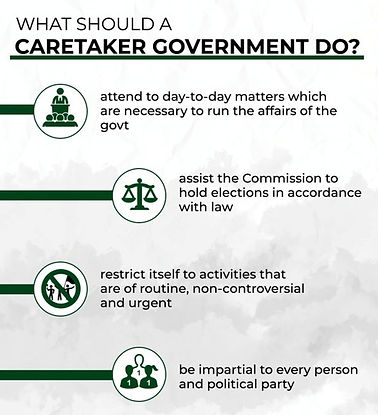
Based on established conventions in parliamentary democracies, a caretaker government operates under a specific set of rules designed to ensure a fair and smooth transition of power. The guiding principle for a caretaker government is to ensure the country continues to function smoothly without making any long-term decisions that should be left to the next elected administration.
During a federal election period, the Prime Minister and ministers keep their positions. When the Governor-General closes the Australian Parliament for a federal election, the government enters a ‘caretaker period’. During this period, the government continues to manage the day-to-day running of the country. However, it does not make any major decisions without first talking to the opposition who could become the next government if it wins the election. The caretaker period lasts until the election result is known. If a new government is elected the Governor-General will commission – formally appoint – a new Prime Minister and ministers. If the existing government is re-elected, the current Prime Minister and ministers are re-commissioned by the Governor-General.
A caretaker government's role is strictly limited to:
-
Routine Administration: Handling the day-to-day business of governing, such as maintaining public services, like education, police, taxes, transportation.


-
Urgent and Essential Matters: Natural disaster or a major international incident that need urgent actions.
-
Pre-Approved Policies: Advancing previous parliament's initiatives, such as a national vaccination drive or ongoing development projects.
The most well-known cases of overstayed caretaker government include Bangladesh and Pakistan.
Bangladesh (1996, 2008): Khaleda Zia of the Bangladesh Nationalist Party (BNP) was elected as Prime Minister of Bangladesh for the first time by the 1991 general election. She was elected again in the following February 1996 general election. The election was organized by Zia's government rather than a neutral caretaker government and was boycotted by the major opposition parties − the Awami League, Jatiya Party and Jamaat-e-Islami. The opposition demanded new elections under a caretaker government. Civil unrest led to these demands being met in late March and an Awami League victory in the June 1996 general election. On 28 March, the 13th amendment to the Constitution of Bangladesh introduced the practice of non-partisan caretaker governments for the holding of general elections.
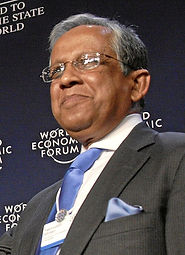
In late 2006, President Iajuddin Ahmed formed a caretaker government. The dispute resulted in violent unrest and the cancellation of the January 2007 general election. Fakhruddin Ahmed formed a new caretaker government in January 2007 backed by the Bangladesh Armed Forces. The caretaker government maintained a limited state of emergency while arresting Awami and BNP members for corruption. The caretaker government was replaced after the 2008 general election, having exceeded the constitutionally-mandated term limit of 120-days. This specific event is so well-known that it is often called the "Bangladesh model" of overstay.
The caretaker government system, which was created to build trust, was ultimately abolished in 2011 by the Awami League government. The official justification was that the 2007-2008 episode had shown the system was vulnerable to abuse and overreach. However, following the High Court Division's verdict, several sections of the Fifteenth Amendment were scrapped on 17 December 2024, restoring the caretaker system.
Pakistan (2023): The caretaker prime minister of Pakistan is the acting head of the Caretaker Government in Pakistan following the dissolution of the National Assembly. The purpose of this post is to ensure free and fair elections are held. The constitution and the Elections Act do not specify an absolute term limit for a caretaker government. However, the convention is that it should serve only until elections are held, and the constitution requires elections to be held within 90 days. The caretaker government's term was meant to be a short prelude to elections. However, the elections were delayed for several months.
_(cropped).jpg)
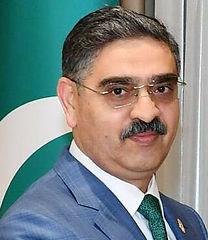
The caretaker government of Pakistan, led by Anwaar-ul-Haq Kakar and installed in August 2023, became the longest-serving interim setup in the country’s history, lasting over 200 days compared to the constitutionally mandated 90 days. The government, initially expected to hand over power by mid-November 2023, remained in office until 4 March 2024, following delays to the general elections, which were ultimately held on February 8, 2024.
Unlike typical caretaker governments, this cabinet made significant policy decisions, including those related to economic reform and international negotiations, facilitated by amendments to the Election Act of 2017 which widened their authority. During this extended period, the government ordered the deportation of all undocumented foreign nationals, primarily Afghans, beginning November 1, 2023, a policy that significantly impacted millions.
The United States has no caretaker governments (neither does Venezuela), but it does limit its presidents to two four-year terms in office. As their second term begins to run out, they inevitably find themselves losing power and influence. They are said to become “lame ducks” as the country turns its attention to younger, healthier ducks who might win the next election. Discuss with your team: to prevent lame ducks, would it be better to have no limits on how long a person can lead a country or organization? What would you advise someone wanting to hold onto power for as long as possible?

In politics, a lame duck is an elected official who is nearing the end of their term, specifically after a successor has been elected, resulting in reduced influence. The term is often used to describe the period between a presidential election and the inauguration of the next president. National Lame Duck Day is observed on February 6 to commemorate the ratification of the 20th Amendment, which shortened this transition period.
The problem of diminished power is that their influence often wanes as political attention shifts toward the incoming president and their new agenda. However, there is also the problem of unchecked action. Because they no longer face reelection, lame ducks are often "liberated" to take controversial or unpopular actions, such as issuing presidential pardons or executive orders, without fear of voter backlash.
Nations with No Presidential Term Limits
-
China: In 2018, the National People's Congress voted to remove the two-term limit on the presidency, effectively allowing Xi Jinping to remain in power indefinitely.
-
North Korea: Under its current political structure, there is no set limit on the tenure of the General Secretary, a position currently held by Kim Jong Un.
-
Belarus: While a 2022 referendum technically reintroduced a two-term limit, it applies only to "newly elected" presidents, allowing the long-serving incumbent Alexander Lukashenko to remain exempt.
-
Venezuela: Following a 2009 referendum, term limits for all elected offices, including the presidency (currently held by Nicolás Maduro), were abolished.
-
Azerbaijan: The country removed its two-term limit for the presidency in 2009, allowing the incumbent to serve unlimited seven-year terms.
-
Absolute Monarchies: Leaders in countries like Saudi Arabia, Oman, Brunei, Qatar, and Vatican City serve for life or until abdication, as their power is not bound by a term-based electoral cycle.
-
Parliamentary Systems: In many democracies like the United Kingdom, Canada, Australia, Italy, and Germany, the Head of Government (Prime Minister or Chancellor) has no direct term limit.
-
While Russia technically has a two-term limit, a 2020 constitutional amendment "reset" the term count for Vladimir Putin. This allows him to run for two additional six-year terms, potentially keeping him in office until 2036.
Queen Elizabeth I’s solution was to delay naming her successor. “I know the inconstancy of the people of England,” she is said to have told the Scottish ambassador, “How they ever mislike the present government and have their eyes fixed upon the person who is next to succeed.” Discuss with your team: would it be better if no one knew who the next leader would be until after the current leader left (or died)? Can you find an example of such a system?
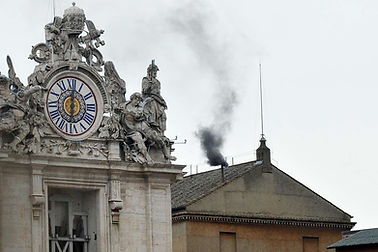
The Vatican is one of these situations. After the pope dies, in a papal conclave, smoke signals from the Sistine Chapel chimney are the traditional method used by the sequestered College of Cardinals to communicate the progress of a papal election to the world. Black Smoke (Fumata Nera) indicates that a round of voting has concluded, but no candidate received the required two-thirds majority. It signals that more voting is required. White Smoke (Fumata Bianca) confirms that a new pope has been elected. This is typically accompanied by the ringing of the bells of St. Peter's Basilica to eliminate any ambiguity regarding the smoke's color. The tradition of burning ballots dates back to at least 1417, but using distinct white smoke as a specific signal for a successful election only began in 1914 with the election of Pope Benedict XV.
Someday there may be nobody left to lead. Consider the Doomsday Clock, which tries to measure how close we are to the end of human civilization. Discuss with your team: how accurate do you think it is, and in what ways, if any, is it a helpful tool?
"Three minutes is too close. Far too close," the members of the Science and Security Board for The Bulletin of the Atomic Scientists announced on Tuesday in a statement. What happens at midnight? Global catastrophe. The Bulletin of the Atomic Scientists first debuted the Doomsday Clock in 1947 as a symbolic way to track how close humanity was to annihilating itself. In the beginning the main concern was nuclear war, but today, nuclear war is just one of many risks that board members weigh when they set the clock's time each January.

It was founded in 1947 by Manhattan Project scientists, including Albert Einstein and J. Robert Oppenheimer, who wanted to warn the public about the dangers of the nuclear age they helped initiate. The original setting was 7 minutes to midnight. The safest point was 17 minutes at midnight of 1991, following the end of the Cold War and signing of nuclear disarmament treaties.
2026 85 seconds Escalating nuclear risks (Russia, China, US), New START treaty nearing expiry, aggressive nationalism, and lack of AI regulation.
2025 89 seconds Nuclear threats, insufficient climate action, and biological risks.
2023-24 90 seconds Primarily the Russian invasion of Ukraine and revived fears of nuclear escalation.

The summary of the 2026 statement:
-
Nuclear Risk: Aggressive rhetoric from nuclear powers and the collapse of arms-control agreements like the New START treaty.
-
Climate Change: Record-breaking global temperatures and the dismantling of environmental regulations.
-
Disruptive Technologies: The unchecked advancement of Artificial Intelligence (AI) in military command and its role in spreading disinformation.
-
Biological Threats: Concerns over laboratory-synthesized "mirror life" and a degraded global public health infrastructure.
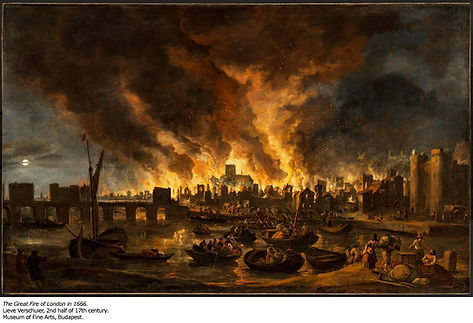
Midnight was coming. The world was on fire and people were dying of a terrible illness. Surely, the end of the world was near—or so thought Londoners in 1666. It was also near in 1844, 1910, 1988, 2000, and 2012. Doomsday predictions come and go more frequently in the social media age, but people have been predicting (and rescheduling) the end of the world for as long as they could hold up signs on street corners. With your team, explore the following instances of imminent doom, and consider: what do they have in common? What leads people to believe them—and what makes a doomsday prediction go viral?

For the people of London, Albrecht Dürer’s ‘Four Horsemen of the Apocalypse’ (1498) was being realized. The woodcut illustrates Revelation 6:1–8, showing the four horsemen—Conquest, War, Famine, and Death—riding as a galloping phalanx rather than sequentially. Dürer depicts Conquest with a bow and arrow, War with a sword, Famine with scales, and Death as an emaciated figure on a skeletal horse, followed by Hades. Unlike earlier biblical illustrations, Dürer injects intense motion and menace, emphasizing the destructive power of these figures while maintaining a realistic depiction of the landscape and weather.
The exact calculation and the ordering of the millennium and the apocalypse were open to debate. In 1660, an anonymous writer going by the alias “Friend to the
Calculations abounded to show why the year 1666 could herald the end of the world or, alternatively, the return of Jesus and the establishment of heaven on Earth. As Europe sweated under the plague, fevered imaginations turned to the future, generating a flurry of inventions and technological advancements.
It was 1666, was one of the most horrific years in European history. London was devasted by a great fire and all the signs from the Bible's Revelations were abound - Death, Famine, War and Plague. Catholics and Protestants, and their royal proxies, had slaughtered one another around Europe, and bubonic fleas crawled from body to body as fast as heresy could be whispered.
Truth” produced a complex calculation and explanation as to why the “Egge of Antichristianisme” would hatch its devilish beast in 1666. In just six years’ time God’s wrath would be unleashed upon the Earth in order to destroy the ghastly creature.
The Fifth Monarchy Men were a radical 17th century Puritan sect in England who believed in the imminent establishment of Christ’s kingdom on Earth, following the four historical monarchies. Their name derives from a prophecy in the Book of Daniel, which described four successive empires—Assyrian, Persian, Greek, and Roman—followed by a fifth monarchy, the eternal kingdom of God. Of course, the world did not end and soon, the Fifth Monarchy Men fell out of popularity. At the same time, apocalyptic and mystical cults flourished as the pamphlets and buboes spread, but so did science and invention. Founders of the Royal Society of London – the pioneering academy of science – believed that the millennium would be marked, or accomplished, by advancing human knowledge to a godlike level. Famous scientist Robert Boyle, yep, father of chemistry and the guy behind Boyle's Law, which describes the inverse relationship between gas pressure and volume saw the end of the world as a time when humans will break the curse of hard work and mortality. Boyle looked to reverse the punishments: for tools to ease human labour, and for “Potent Druggs to alter or Exalt Imagination [and] Memory” to correct lapsed intellectual powers.
These people that aspire to create a new world order to fix a broken system are called 'imagineries' by sociologists. Natural philosophers imagined both the type of world they wanted to live in (a godly one), and the types of science and technology that would enable and define such a world. Even though the imagineries of the 1600s did not ease human labor or find ways for humans to fly like angels they developed telescopes, microscopes, and social norms for agreeing and disseminating their findings, and in doing so they did indeed extend the limits of knowledge and lessen – for a lucky minority – the grind of labour.
There is a deadly fascination with doomsday since early in history, some religious, some cultural, astronomical, and some frankly are pure-cult. Eschatology concerns expectations of the end of present age, human history, or the world itself. The end of the world or end times is predicted by several world religions (both Abrahamic and Indian), which teach that negative world events will reach a climax. Belief that the end of the world is imminent is known as apocalypticism, and over time has been held both by members of mainstream religions and by doomsday cults. Here is Britannica's top 10 failed doomsday prediction.
#10 2012 Maya Apocalypse
December 21, 2012, marked the end of the first “Great Cycle” of the Maya Long Count calendar. Many misinterpreted this to mean an absolute end to the calendar, which tracked time continuously from a date 5,125 years earlier, and doomsday predictions emerged.

#9 Harold Camping
Among the most prolific modern predictors of end times, Harold Camping has publicly predicted the end of the world as many as 12 times based his interpretations of biblical numerology. In 1992, he published a book, ominously titled 1994?, which predicted the end of the world sometime around that year. Perhaps his most high-profile predication was for May 21, 2011, a date that he calculated to be exactly 7,000 years after the Biblical flood. When that date passed without incident, he declared his math to be off and pushed back the end of the world to October 21, 2011.
#8 True Way
Taiwanese religious leader Hon-Ming Chen established Chen Tao, or True Way, a religious movement that blended elements of Christianity, Buddhism, UFO conspiracy theories, and Taiwanese folk religion. Chen preached that God would appear on U.S. television channel 18 on March 25, 1988, to announce that he would descend to Earth the following week in a physical form identical to Chen. The following year, he prophesized, millions of devil spirits, together with massive flooding, would result in a mass extinction of the human population. Followers could be spared by buying their way aboard spaceships, disguised as clouds, sent to rescue them.


#7 Halley’s Comet Panic
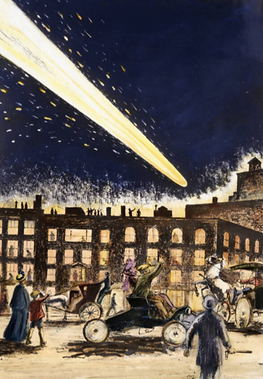
Halley’s comet passes by the Earth approximately every 76 years, but the nearness of its approach in 1910 created fear that it would destroy the planet, either by a celestial collision or through the poisonous gasses it was rumoured to contain. A worldwide panic ensued, stoked by the media and such newspaper headlines as “Comet May Kill All Earth Life, Says Scientist.” A group in Oklahoma tried to sacrifice a virgin to ward off impending doom, and bottled air became a hot commodity. The Earth probably did pass through part of the comet’s tail, but with no apparent effect.
#6 Millerism
Religious leader William Miller began preaching in 1831 that the end of the world as we know it would occur with the second coming of Jesus Christ in 1843. He attracted as many as 100,000 followers who believed that they would be carried off to heaven when the date arrived. When the 1843 prediction failed to materialize, Miller recalculated and determined that the world would actually end in 1844. Follower Henry Emmons wrote, “I waited all Tuesday, and dear Jesus did not come … I lay prostrate for 2 days without any pain—sick with disappointment.”
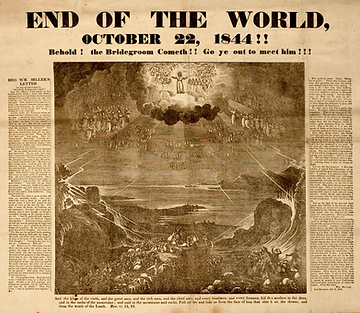
The event became to be known as The Great Disappointment, which he called the Second Advent. His study of the Daniel 8 prophecy during the Second Great Awakening led him to conclude that Daniel's "cleansing of the sanctuary" was cleansing the world from sin when Christ would come, and he and many others prepared.

#5 Joanna Southcott
42 years old, Joanna Southcott was probably going nuts and hallucinating hearing voices that predicted future events, including the crop failures and famines of 1799 and 1800. She began publishing her own books and eventually developed a following of as many as 100,000 believers. In 1813, she announced that in the following year she would give birth to the second messiah, whose arrival would signal the last days of the Earth—despite being 64 years old and, as she told her doctors, a virgin. She died before a baby could be born.
#4 The Prophet Hen of Leeds
In 1806, a domesticated hen in Leeds, England, appeared to lay eggs inscribed with the message “Crist is coming. (yes, with the bad spelling)” Great numbers of people reportedly visited the hen and began to despair of the coming Judgment Day. It was soon discovered, however, that the eggs were not in fact prophetic messages but the work of their owner, who had been writing on the eggs in corrosive ink and reinserting them into the poor hen’s body. Shame on her! There is more... the woman that was behind all this was Mary Bateman and she was a follower of Joanna Southcott. A lifelong con artist and scammer, she was finally hung.

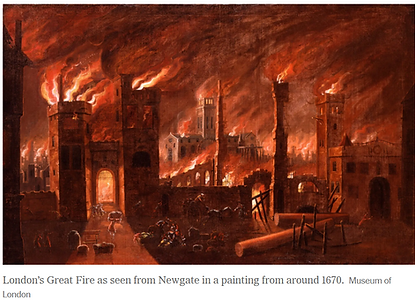
#3 Great Fire of London
Because the Bible calls 666 the number of the Beast, many Christians in 17th-century Europe feared the end of the world in the year 1666. The Great London Fire, which lasted from September 2 to September 5 of that year, destroyed much of the city, including 87 parish churches and about 13,000 houses.
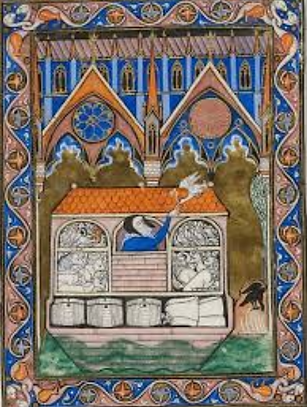
#2 The Great Flood
Johannes Stöffler, a respected German mathematician and astrologer, predicted that a great flood would cover the world on February 25, 1524, when all of the known planets would be in alignment under Pisces, a water sign. Hundreds of pamphlets announcing the coming flood were issued and set in motion a general panic; Count von Iggleheim, a German nobleman, went so far as to build a three-story ark. Though there was light rain on the day of the predicted flood, no actual flooding materialized. Crowds of people—hoping to gain a seat on Iggleheim’s ark—began to riot. Hundreds were killed and the count was stoned to death.
#1 Montanism
Montanism, a 2nd century schismatic movement of Christianity, began in Phrygia (modern Turkey). Based on the visions of Montanus, who claimed to speak under the influence of the Spirit, Montanists believed the second coming of Christ to be imminent. Many Christian communities were almost abandoned when believers left their homes and migrated to a plain between the two villages of Pepuza and Tymion in Phrygia, where Montanus claimed the heavenly Jerusalem would descend to Earth. According to opponents, the Montanist prophets did not speak as messengers of God; instead, they believed they became fully possessed by God and spoke as God.
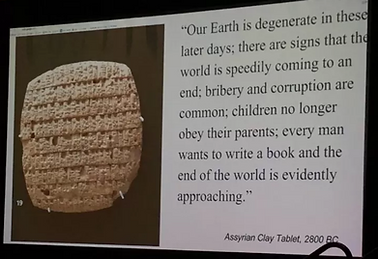
1. The First Warnings From Assyria
An Assyrian clay tablet dating to around 2800 B.C. bears the inscription: “Our Earth is degenerate in these later days; there are signs that the world is speedily coming to an end; bribery and corruption are common; children no longer obey their parents; every man wants to write a book and the end of the world is evidently approaching.” The world didn’t end (just look around), and despite the plague of corruption and petulant teenagers, four centuries later the Assyrians would establish an empire that eventually encompassed most of the Near East.
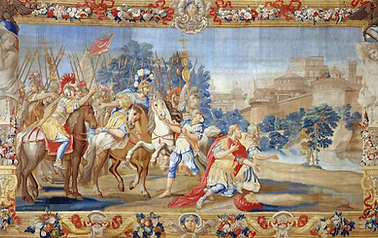
2. Crusaders’ Concerns
Pope Innocent III relied upon apocalyptic theology in his efforts to rally Europe to launch a fifth crusade to capture Jerusalem and the rest of the Holy Land from the Ayyubid Empire. He identified the rise of Islam as the reign of the Antichrist—whose defeat would usher in the Second Coming. The predicted date was 1284. Seven years later, the last crusader kingdom fell, when the Sultan Khalil conquered the city of Acre, in present-day Israel. The rest of the world, however, remained intact.
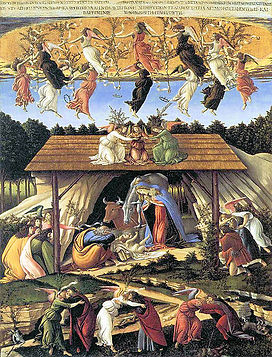
3. Botticelli Paints His Fears (see details below)
Expectations of the apocalypse found their expression in the art of the period—most famously in The Mystical Nativity, painted by Italian Renaissance master Sandro Botticelli. The lower part of the painting depicts several small devils wedged under rocks or pinned to the ground, while a Greek inscription offers this gloomy prediction: “I, Sandro, painted this picture at the end of the year 1500 in the troubles of Italy in the half time after the time according to the eleventh chapter of St. John in the second woe of the Apocalypse in the loosing of the devil for three and a half years. Then he will be chained in the twelfth chapter and we shall see him trodden down as in this picture.” (That would place the apocalypse at around A.D. 1504.)
4. The Germanic Flood That Never Came - See above
5. Black Skies Over New England
At 9 a.m. on May 19, 1780, the sky over New England was enveloped in darkness. An 1881 article in Harper’s Magazine stated that, “Birds went to roost, cocks crowed at mid-day as at midnight, and the animals were plainly terrified.” The unnatural gloom is believed to have been caused by smoke from forest fires, possibly coupled with heavy fog. But at the time, some feared the worst. “People [came] out wringing their hands and howling, the Day of Judgment is come,” recalled a Revolutionary War fifer.
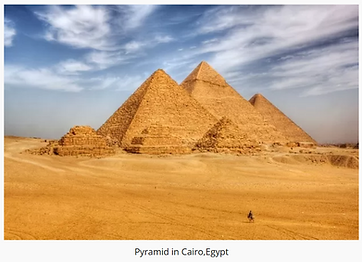
6. Finding Omens in the Great Pyramid of Giza
Supporting “evidence” for an apocalypse in 1881 came from an unlikely source: the Great Pyramid of Giza. Charles Piazzi Smyth, the Astronomer Royal for Scotland, became convinced that the pyramid had been built not by the Egyptians but by an Old Testament patriarch (perhaps Noah) under divine guidance. As such, Smyth saw theological implications in just about every measurement of the Great Pyramid, including a calculation for the End of Days.
Smyth’s research was satirized in a January 5, 1881, column in the New York Times: “In the great gallery of the pyramid… there are precisely eighteen hundred and eighty-one notches… hence if the pyramid is trustworthy and really knows its business, we have arrived at the last year of the earth. There are a vast number of people who believe in this remarkable theory of the pyramid, and they are one and all perfectly sure that the pyramid cannot tell a lie… in case they should happen to be disappointed and to be under the unpleasant necessity of making New Year’s calls in the snow on the First of January 1882, they will probably blaspheme the pyramid and lose all faith in man and stones.”


#7 Beware of Halley’s Comet - See above
#8 Planets Align, Nothing Happens
In 1974, John Gribbin and Stephen Plagemann wrote a best-selling book, The Jupiter Effect, warning that in March 1982, an alignment of the major planets on the same side of the Sun would trigger a series of cosmic events – culminating in an earthquake along the San Andreas fault that would wipe out Los Angeles. The book had an aura of credibility, since both authors were Cambridge-educated astrophysicists and Gribbin was an editor at the prestigious science magazine Nature. Several scientists criticized The Jupiter Effect, saying its argument was based on a tissue-thin chain of suppositions. (Seismologist Charles Richter of Caltech called the thesis “pure astrology in disguise.”) Worldwide panic occurred and then another great disappointment. One year after the non-doomsday event, Gribbin and Plagemann published The Jupiter Effect Reconsidered. It was also a best-seller.
#9 Y2K Panic
At least during this apocalyptic scare, there was someone to blame: Over the decades, computer programmers had used two, rather than four digits, to represent years. As such, computers would allegedly go haywire on January 1, 2000, since the dumb machines would not be able to make sense of the year “00”—and thus the dreaded “Y2K Bug” was born. Some pundits defended the programmers, noting that their actions had been a logical way to conserve precious computer memory and save money. Others were less flattering. “What led to the Y2K Bug was not arrogant indifference to the future,” wrote Brian Haynes in The Sciences Magazine. “On the contrary, it was an excess of modesty. (‘No way my code will still be running 30 years out.’) The programmers could not envision that their hurried hacks and kludges would become the next generation’s ‘legacy systems.’” A September 1999 poll conducted by the Wall Street Journal found that 9 percent of Americans believed Microsoft was hiding the solution to the problem.

#10 A Man-Made Black Hole?
Ever since the early 1990s, the media has reported that the Large Hadron Collider (LHC) could potentially create a black hole that would swallow the Earth. The LHC—which was switched on in September 2008—is 17 miles in circumference and buried 570 feet beneath the Alps on the Swiss-French border. The collider has the capacity to smash together proton beams at velocities up to 99.99 percent of the speed of light. In doing so, it can simulate the conditions and energies that existed shortly after the start of the Big Bang—thereby providing insights into critical questions as to how our universe was formed.
The Simpsons episode that deals with the theme of the end of the world is titled "Thank God It's Doomsday". In this episode, Homer calculates the date of the Rapture and panics Springfield into believing that the end is near. Ultimately, he is proven wrong, leading to mixed feelings among the townspeople.
Bart, Lisa, and Homer duck into the mall movie theater after Bart and Lisa have a mishap at the new barber and have to avoid the school's camera club. Inside, Homer watches a movie about the end of the world as foretold in the Bible, leading Homer to do a little research and work out that the Apocalypse begins in one
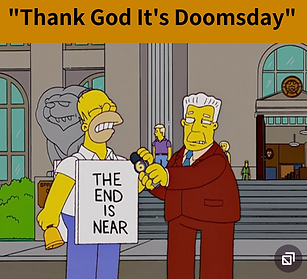
week. Nobody listens to him, until he makes a prediction that "the stars will fall to the Earth", which is exactly what happens when a celebrity-filled blimp crashes, and soon Homer has a pack of followers who join him for the end"- and then desert him when the end doesn't happen, and don't listen to him when he discovers a mistake in his calculations (he counted 12 people at the last supper, but forgot to count Jesus, making 13) - especially Moe, who sold his bar to a company that turned it into a sushi restaurant.
-
The Millerites (1844) | Wodziwob’s visions (1869) | Halley’s Comet Panic (1910)
-
The Jupiter Effect (1974) | Hon-Ming Chen (1988) | The Y2K bug (2000)
-
Large Hadron Collider (2008) | Mayan Apocalypse (2012)
Some of these that were already discussed, please see above. Only one was not covered and here it is.
Wodziwob (died c. 1872) was a Paiute prophet and medicine man who is believed to have led the first Ghost Dance ceremonies, in what is now Nevada, sometime around 1869. The first vision proclaimed that "within a few moons there was to be a great upheaval or earthquake... [during which] the improvements of the whites-all their houses, their goods, stores, etc.-would remain, but the whites would be swallowed up, while the Indians would be saved and permitted to enjoy the earth and all the fullness thereof, including anything left by the wicked whites". The prediction of this selective earthquake was

met with skepticism. After a second trip to the mountain, Wodziwob received a new prophecy that stated that all peoples would be swallowed by the earthquakes, and after a few days the Native Americans would return to the world, now a paradise, while the whites would be destroyed. However, after no earthquakes happened according to his prediction, people became disenchanted. This prompted him to make a third trip to the mountain, where it was revealed to him that those "who believed in the prophecy would be resurrected and be happy, but those who did not believe in it would stay in the ground and be damned forever with the whites". An additional prophecy stating that a train carrying the dead would come from the east within four years.
The four horsemen of the apocalypse, fires raging across more than California: the Book of Revelation has long offered artists a rich source of imagery for the end of the world. As you explore the following works from the European Renaissance, ask yourself: how does each artist distinguish between the destinations of the saved and the doomed—and is their tone one of terror or acceptance?
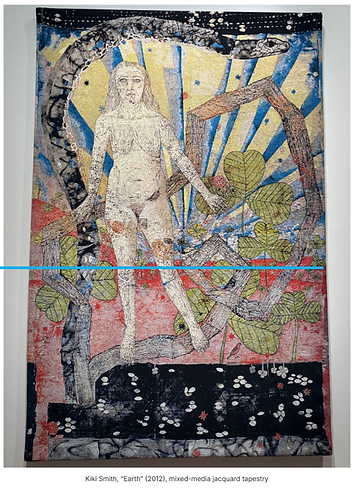
This article summarizes a Paris exhibition at Bibliothèque nationale de France (BnF) titled Apocalypse: Today and Tomorrow that traces artists’ obsession with the Apocalypse, from rare Medieval illuminated manuscripts to Blake, Kandinsky, and Kiki Smith.
The Book of Revelation, previously called the Apocalypse, is the Bible’s most ekphrastic text. With vivid allegorical imagery, its author, John of Patmos, sought to cajole readers into choosing virtue over vice before it was too late. The popular fixation on the end of the world glosses over this ethical imperative: John of Patmos’s overriding concern was moral complacency in the here and now. The fear that this year might be our last was meant to motivate better choices today.
In Revelation 12, for one, John of Patmos envisions an epic battle between a dragon and a woman clothed with the sun. Two centuries later, in 1498, Albrecht Dürer would illustrate this scene in his iconic series of 15 woodcuts.


The Whore of Babylon in Revelation 17 is perhaps John of Patmos’s most notorious character. It may be tempting to lambast her as the misogynistic result of early Christian slut-shaming. But many scholars believe that John of Patmos was in fact playing with a lesser-known metaphorical tradition in Jeremiah, Ezekiel, and Hosea, in which prophets called out men for “spiritual whoring,” or betraying the Shema’s command to love god and instead lusting after worldly power, wealth, and status. Blake's topless version is wrong in making it about eroticism instead of scorning the pursuit of wealth.
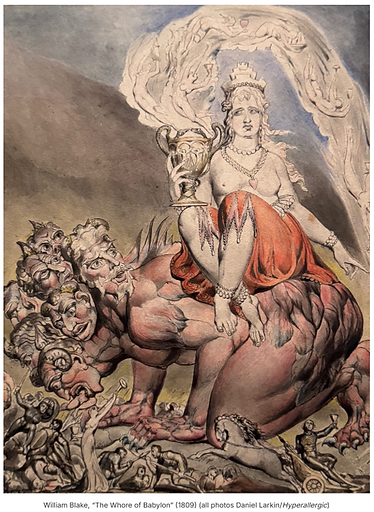
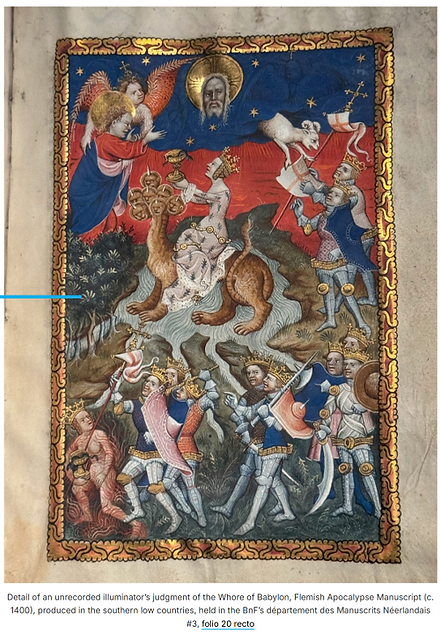
Finally, in the Last Judgment in Revelation 20, God metes out punishment to the wicked and rewards the virtuous. Wassily Kandinsky portrayed the Last Judgement in his characteristically abstract painting “Jüngster Tag” (1912), in which two amorphous entities appear to separate, alluding to good on one side and evil on the other. However, most modern and contemporary artists included in this exhibition were not interested in the Book of Revelation. Their works focused on the destructive impulses of war and modern society.


Albrecht Dürer | The Four Horsemen of the Apocalypse (1498)
Albrecht Dürer was a German painter, printmaker, and theorist of the Northern Renaissance, celebrated for revolutionizing woodcuts and engravings with unprecedented detail, tonal range, and complexity. Influenced by Italian masters, he integrated classical ideals with Northern detail in works like Adam and Eve, Knight, Death, and the Devil, and the Apocalypse series. On the right is a famous self-portrait of the artist. (I always thought he looks a bit like the stereotypical Jesus in classical paintings.)
The third and most famous woodcut from Dürer's series of illustrations for The Apocalypse, the Four Horsemen presents a dramatically distilled version of the passage from the Book of

Revelation (6:1–8): "And I saw, and behold, a white horse, and its rider had a bow; and a crown was given to him, and he went out conquering and to conquer. When he opened the second seal, I heard the second living creature say, 'Come!' And out came another horse, bright red; its rider was permitted to take peace from the earth, so that men should slay one another; and he was given a great sword. When he opened the third seal, I heard the third living creature say, 'Come!' And I saw, and behold, a black horse, and its rider had a balance in his hand; ... When he opened the fourth seal, I heard the voice of the fourth living creature say, 'Come!' And I saw, and behold, a pale horse, and its rider's name was Death, and Hades followed him; and they were given great power over a fourth of the earth; to kill with sword and with famine and with pestilence and by wild beasts of the earth." Dürer injects motion and danger into this climactic moment through his subtle manipulation of the woodcut. The parallel lines across the image establish a basic middle tone against which the artist silhouettes and overlaps the powerful forms of the four horses and riders—from left to right, Death, Famine, War, and Plague (or Pestilence).
-
Death on his skeletal horse, wielding what looks like a trident.
-
Famine, carrying the scales.
-
War, wielding a great sword.
-
Plague (or Pestilence), the first rider, with his bow and crown.


Sandro Botticelli | The Mystical Nativity (1500)
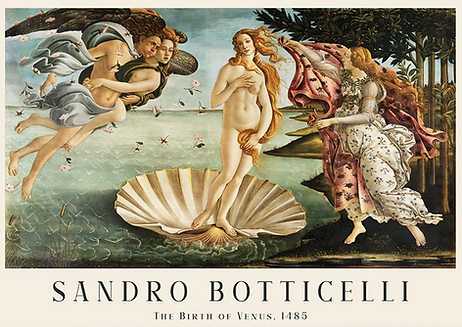
A masterpiece of the National Gallery, Sandro Botticelli's Mystic Nativity (c. 1500) is a small, profoundly personal painting that stands apart from his more famous mythological works like The Birth of Venus . Currently housed in the National Gallery in London, it is the only work Botticelli ever signed, and it combines the traditional Christmas story with a prophetic vision of the end of the world.
With No fewer than 20 angels – all carrying leafy olive branches, a symbol of peace – preside over the revelry, the event takes place in a glade within a forest; the stable where, according to the Gospel writers, Christ was born, is represented imaginatively as a thatched roof pitched over the opening of a rocky cavern. (very different from the usual Bethlehem version.) Above the baby Christ are 12 angels holding olive branches entwined with scrolls and hung with crowns which swing as they dance. Among their feet, winged demons and horned little devils scuttle for shelter in the underworld through cracks in the rocks. This is an unusual sight in a nativity scene but it is key to the understanding of Botticelli’s mystical creation. In this, Botticelli interprets contemporary political events – which he calls ‘the troubles of Italy’ – in the light of the biblical Book of Revelation, which foretells the details of the end of the world and Christ’s second coming. The ‘troubles’ are probably a reference to the invasion of the French, who took Naples in 1494 and Milan in 1499, and to the civil strife in Florence itself. Botticelli has associated these events with chapter 11 of Revelation, which describes the invasion of the Holy City by Gentiles and the devil being unleashed. Christ’s return to earth would bring an end to this period of upheaval and the devil would be buried, as in this picture. Botticelli was likely influenced by the teachings of Girolamo Savonarola, a radical preacher who led Florence after the fall of the Medici family.
-
Overlapping Realms: The golden dome of heaven opens directly above the humble manger, with twelve angels circling it. This collapses the divide between the divine and earthly realms .
-
Angels and Men Embracing: In the foreground, three pairs of angels and men embrace. This is a motif typically associated with the Last Judgment and the Second Coming of Christ, not his birth .
-
Defeated Demons: At the very bottom, seven tiny demons flee into cracks in the earth and impale themselves on their own weapons, symbolizing the devil's defeat .
-
Symbols of Future Sacrifice: The sheet the infant lies on resembles a burial shroud, and the manger sits in front of a cave, foreshadowing his tomb
After Botticelli's death in 1510, the painting and the artist fell into obscurity for centuries . It was rediscovered in the 19th century, having been bought for a low price in Rome by an English collector. Its exhibition in Manchester in 1857 was a sensation, playing a major role in the Victorian revival of interest in Botticelli's work.
Michelangelo | The Last Judgment (1536–1541)
When Michelangelo began this work at age 60, he was already famous for the Sistine Chapel ceiling, painted 25 years earlier. The Last Judgement broke dramatically from tradition in its composition and conception. The mighty composition centred around the dominant figure of Christ, captured in the moment preceding that when the verdict of the Last Judgement is uttered (Matthew 25: 31-46). His calm imperious gesture seems to both command attention and placate the surrounding agitation.
-
Key Figures: Surrounding Christ is the Virgin Mary, who turns her head in resignation . They are joined by saints identifiable by their traditional symbols of martyrdom: St. Bartholomew holds his flayed skin (which bears a self-portrait of Michelangelo) ; St. Peter holds the keys to heaven; St. Lawrence carries a gridiron; and St. Catherine of Alexandria is with a cogwheel .
-
Dante and Classical Mythology: Michelangelo drew heavily on Dante's Divine Comedy. In the bottom right, the mythological ferryman Charon swings an oar, driving the damned from his boat into hell, where the infernal judge

Minos awaits. He wrapped Minos in a serpent's coils, famously using the face of a critical Vatican official, Biagio da
Cesena, as revenge .
-
Awakening the Dead: In the center-lower section, angels sound long trumpets to awaken the dead, who rise from their graves to face judgment .
The controversies, that continued for years, led in 1564 to the decision by the Congregation of the Council of Trent to have some of the figures of the Judgement that were considered "obscene" covered. The task of painting the covering drapery, the so-called "braghe" (pants) was given to Daniele da Volterra, since then known as the "braghettone".
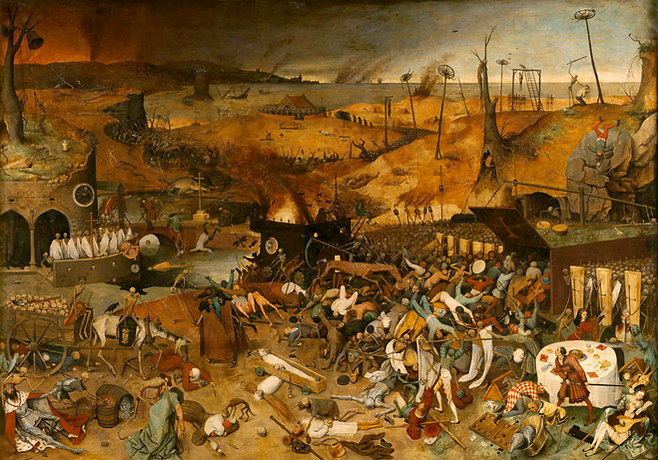
Pieter Bruegel the Elder | The Triumph of Death (c. 1562)
Consider the more recent apocalypses depicted below. How have they changed as the world has moved toward industrial and digital anxiety—and what specific fears are these artists inviting us to explore?
The panoramic landscape devoid of hope: the sky is black with smoke from burning cities, the sea is littered with shipwrecks, and the land is barren and scorched. This is not a spiritual allegory but a physical massacre. Bruegel fills every inch of the canvas with chaos. Armies of skeletons advance on the living methodically kill, torture, and hunt humans using contemporary methods of execution. A central theme of the work is that death is the great equalizer. Bruegel meticulously shows that social status offers no protection.
-
A wagon full of skulls is pulled by horses, crushing a woman who has fallen in its path.
-
A skeleton on horseback wields a scythe, cutting down people who are herded into a coffin-shaped trap decorated with crosses.
-
Skeletal hunting dogs chase a human prey, while a skeleton hunter strangles a man in a fishing net.
-
A cross sits impotently in the center of the painting, surrounded by carnage, suggesting that traditional faith offers no protection from this onslaught.
-
A king lies dying on the ground as a skeleton loots his barrel of gold coins.
-
A cardinal is helped toward his fate by a skeleton who mockingly wears the red hat.
-
A lavish dinner party has been interrupted. Nobles draw their swords in a futile last stand, a jester hides under the table, and a skeleton wearing a mask empties the wine flasks while another embraces a woman in a grotesque parody of romance.
-
A fool plays a lute while a skeleton behind him plays along, unaware or uncaring that his time has come.
The painting was created around 1562, a period of immense religious and political turmoil in the Spanish Netherlands (roughly modern-day Belgium and the Netherlands). The region was on the brink of the Eighty Years' War (1568-1648), and the Protestant Reformation was being met with brutal repression by the Spanish Catholic authorities. Scholars believe The Triumph of Death is a direct commentary on this escalating violence created by mankind's warfare.
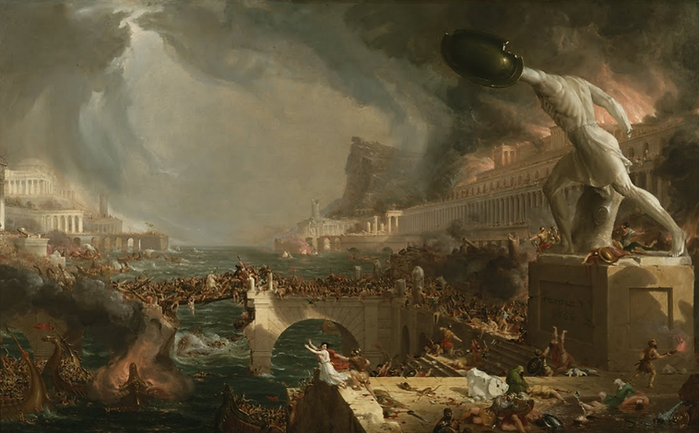
Thomas Cole | The Course of Empire: Destruction (1836)
WSC favorite Thomas Cole is back. You might remember his landscape The Oxbow featuring the Hudson River Valley. This work from later in his career depicts the rise and fall of civilizations. Interestingly, the artwork is likely a warning to the America about the evils of imperialism. He had been likely studying Gibbon's The History of the Decline and Fall of the Roman Empire.
The Course of Empire is a five-painting cycle that traces the rise and fall of an imaginary classical civilization. Cole conceived it as a visual warning to his contemporary American audience, then witnessing rapid expansion and industrialization. The five paintings are:
-
The Savage State – The pastoral, primitive beginning.
-
The Arcadian or Pastoral State – The idyllic, harmonious early civilization.
-
The Consummation of Empire – The peak of opulence, luxury, and imperial power.
-
Destruction – The violent collapse.
-
Desolation – The silent, mournful ruins.
This is the fourth and most dramatic painting of the series depicts the ruin of civilization. In the vainglorious city, a colossal figure, modeled on the Borghese Warrior, witnesses the rapacious acts of the invading army. He has lost his head, signaling the loss of rational control and reign of brute force.
-
The Central Bridge: A massive stone bridge, once a symbol of engineering triumph, crumbles under the weight of soldiers, horses, and fleeing civilians. The central arch gives way, sending figures plunging into the river below.
-
The Statue: The colossal statue of a heroic warrior, which stood prominently at the river's edge in Consummation, now topples forward, decapitated and broken. It is a literal representation of the fall of imperial power.
-
The Boat: In the foreground, a boat carries fleeing citizens. A woman in red, silhouetted against the chaos, desperately reaches toward the shore as the city burns behind her. Her gesture echoes classical compositions of despair.
-
The Conqueror: On the right, a triumphant conqueror on a white horse rides forward, framed by a massive column that is about to collapse on him—a subtle suggestion that his victory, too, will be fleeting.
John Martin | The Great Day of His Wrath (1851–1853)

Along with the other two vast panels, The Last Judgement and The Plains of Heaven, it was inspired by St John the Divine's fantastic account of the Last Judgement given in Revelation, the last book of the New Testament. Martin's aim in producing this series was highly Romantic: to express the sublime, apocalyptic force of nature and the helplessness of man to combat God's will. Of all Martin's biblical scenes, this presents his most cataclysmic vision of destruction, featuring an entire city being torn up and thrown into the abyss.
The Book of Judgement is sealed with seven seals. As each seal is broken, mysterious and terrifying events occur, culminating in the breaking of the sixth seal: and, lo, there was a great earthquake' and the sun became black as sackcloth of hair, and the moon became as blood; | And the stars of heaven fell unto the earth, even as a fig tree casteth her untimely figs, when she is shaken of a mighty wind. | And the heaven departed as a scroll when it is rolled together; and every mountain and island were moved out of their places. (Revelation 6:12-14)
Otto Dix | World War I prints (1924)
Otto Dix's Der Krieg (The War), a portfolio of 50 etchings published in 1924, stands as one of the most devastating anti-war statements in the history of art. In this way, he compares the cruel trench warfare of WWI to the apocalypse of Revelations. Created a decade after the start of World War I, it is an unflinching visual record of the conflict's brutal reality, rendered by an artist who experienced the trenches firsthand.
He volunteered for the German army in 1914 and served as a machine gunner on both the Eastern and Western Fronts, including the infamous Battle of the Somme, where he was seriously wounded multiple times . Initially, he had embraced Friedrich Nietzsche's philosophy and saw war as an inevitable, even exhilarating, force . However, the brutal reality of trench warfare transformed him. By 1924, he was no longer a willing soldier but a searing critic, using his art to process the trauma he had endured. Dix deliberately arranged the images in a random order to evoke the chaos and psychological fragmentation of war, rather than any neat narrative. Unlike heroic war art, Dix focused exclusively on the aftermath: dead, dying, and decomposing soldiers; bombed-out landscapes; and makeshift graves.

Stormtroops advancing under a gas attack. Gas clouds the atmosphere in this other-worldly scene. The figures' features are obscured by masks and their fingers are curled like claws.

Corpse of a horse. Men were not the only victims. The war destroyed anything in its path.
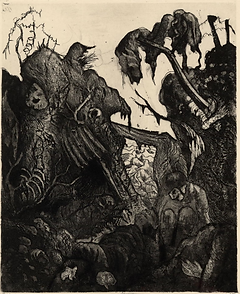

Collapsed trenches. For all its discomfort, the trench was home. Here the enemy managed to destroy a section of home and the scene is depicted almost as Armageddon. Two pieces of tattered cloth hover above the soldier. One resembles the Reaper, the other a vulture.
Transporting the Wounded in Houthulst Forest. During the war the automobile was put to work as an ambulance. Trains and steam ships carried the wounded to hospitals. Despite such advances, a wounded man often relied on comrades to get him off the field.

Front-line Soldier in Brussels. A soldier lurks in darkness surrounded by voluptuous whores in expensive clothing. In this view, they are nothing more than war profiteers. In reality they lived in dire poverty.
Skull. The war provided a windfall for scavengers such as worms and maggots. Trench rats roamed as big as beavers. Gas was sometimes a welcome respite as it decimated these pests.


Crater field near Dontrien lit up by flares. Throughout the series, Dix demonstrates a commanding use of print techniques with etching, dry point and aquatint. Here a night-time flare illuminates a lunar landscape.

Dead sentry in the trenches. Throughout this series, Dix presents a wide array of ways in which a soldier can meet his death. Here, a soldier remains posed in the exact position he held at the moment the sniper's bullet found its target.
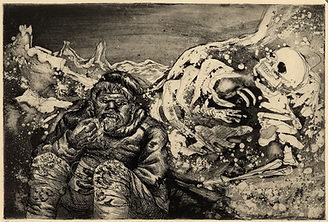
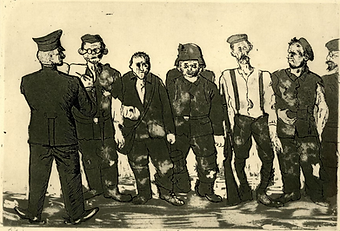
Mealtime in the Trenches. A trench soldier quickly gulps down a meal in the company of a human skeleton trapped in the frozen landscape beside him.
Roll Call of Returning Troops. The war took a great toll on all its participants. Here the living are barely distinguishable from the dead. They report to a well-fed administrative officer in a clean suit.
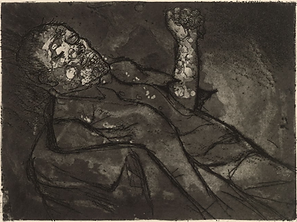
Dead man in the mud. Mud defined a soldier's experience on the Western Front. He marched in it, slept in it, fought in it and often died in it. For the artist it offered rich textures which Dix captured nicely with aquatint.
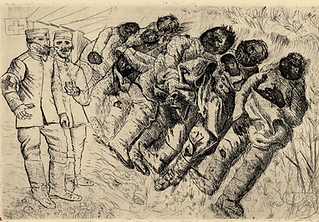
Gas victims, August 1916 (Gastote). By 1924, people were aware of the horrors of gas but censored wartime reporting spared many from its ghastly details. Here the results are depicted with the raw clarity of someone who was there. Many were probably struck by the appearance of the victims, darkened for lack of oxygen, and the nonchalance of the medical staff.
Viktor Schreckengost | Apocalypse ‘42 (1942)
Viktor Schreckengost's Apocalypse '42 (1942) is a powerful ceramic sculpture that captures the anxiety and moral outrage of the early years of World War II. Schreckengost created Apocalyse 42' just a few months after the Japanese attack on Pearl Harbor on December 7, 1941
The sculpture depicts a terrified, rearing horse carrying four riders across the globe. This imagery is a direct reimagining of the Four Horsemen of the Apocalypse, a theme previously explored by artists like Albrecht Dürer.

-
The Riders: The horse carries Adolf Hitler, Benito Mussolini, and Emperor Hirohito—the leaders of the Axis powers—along with a skeletal figure of Death . By placing them together on a single horse, Schreckengost condemns them as a unified force of destruction.
-
The Horse: Unlike traditional depictions where the horsemen ride separate mounts, here a single horse is shown in a state of terror. Its wide eyes and bared teeth convey horror at the burden it is forced to carry, suggesting that even nature recoils from fascism.
-
The Globe: The horse gallops across a sculpted globe, emphasizing that this is a world war and a global crisis.
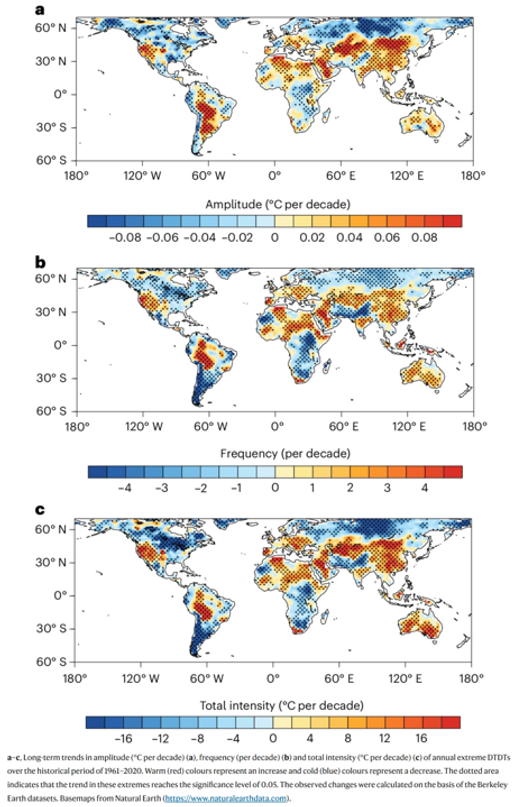
Global warming is increasing the number and intensity of many extreme weather and climate events. Here we argue that extreme day-to-day temperature changes, exceeding the 90th percentile threshold of historical records, are an independent, but largely ignored, aspect of extreme weather events. Such extreme temperature changes have a stronger impact on human health in many locations than do diurnal temperature variations. Global observations show that such events have become more frequent since the 1960s in low and mid-latitudes but decreased at high latitudes, primarily due to GHG forcing. Climate models project a further amplification of extreme day-to-day temperature changes under warming, with frequency, amplitude and total intensity rising by ~17%, ~3% and ~20%, respectively, by 2100 in regions covering 80% of global population. Increased extreme day-to-day temperature changes are associated with drier soil and increased variability in pressure and soil moisture, posing substantial risks to societal and ecosystem resilience and adaptation.
Extreme Day-to-Day Temperature Changes (DTDT) are defined as the absolute difference in daily maximum temperature between two consecutive days exceeding the historical 90th percentile. This study argues these
events are largely independent from 15 standard temperature extreme indices (e.g., heatwaves, diurnal range), with 90–99% of land areas showing no significant correlation.
Increase in low and mid-latitudes have taken place with amplitude, frequency, and total intensity rising significantly every decade. Regions like eastern China, western USA, and the Mediterranean are hotspots. Decrease has also occurred at high latitudes: Northern high latitudes show a decline, linked to Arctic amplification weakening the meridional temperature gradient. These extreme events account for 70–80% of the total change in day-to-day temperature variability.
Two record-breaking events in 2022 (eastern China and western USA) that occurred once every 1,000–3,000 years between 1950–1985 now occur once every 40–60 years, reflecting a rapid increase in likelihood. These changes will impact mortality more in places where the temperature becomes warmer.
Projected changes in the annual extreme DTDT for the daily maximum temperature in a warming climate.



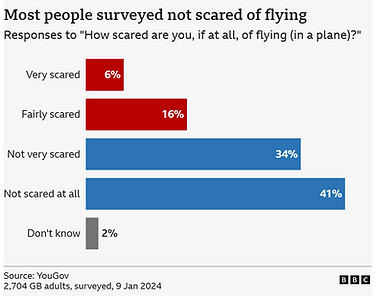
I for one dread turbulence. I know it is unlikely to kill me, but the anxiety of freefall gives me chills. But as climate change shifts atmospheric conditions, experts warn that air travel could become bumpier: temperature changes and shifting wind patterns in the upper atmosphere are expected to increase the frequency and intensity of severe turbulence.
"We can expect a doubling or tripling in the amount of severe turbulence around the world in the next few decades," says Professor Paul Williams, an atmospheric scientist at the University of Reading. "For every 10 minutes of severe turbulence experienced now, that could increase to 20 or 30 minutes."
Severe turbulence is defined as when the up and down movements of a plane going through disturbed air exert more than 1.5g-force on your body - enough to lift you out of your seat if you weren't wearing a seatbelt. Estimates show that there are around 5,000 incidents of severe-or-greater turbulence every year, out of a total of more than 35 million flights that now take off globally. Of the severe injuries caused to passengers flying throughout 2023 - almost 40% were caused by turbulence. The route between the UK and the US, Canada and the Caribbean is among the areas known to have been affected. Over the past 40 years, since satellites began observing the atmosphere, there has been a 55% increase in severe turbulence over the North Atlantic.
There are three main causes of turbulence: convective (clouds or thunderstorms), orographic (air flow around mountainous areas) and clear-air (changes in wind direction or speed). Convective and orographic are often more avoidable - it is the clear-air turbulence that, as the name might imply, cannot be seen. Sometimes it seemingly comes out of nowhere. Clear-air turbulence could also soon rise. It is caused by disturbed air in and around the jet stream, (a fast-moving wind at around six miles in the atmosphere, which is the same height as where planes cruise).
But, don't freak out. Planes are a lot stronger than you think. In fact, it is very flexible. Aircraft wings are, however, designed to fly through turbulent air. As Chris Keane, a former pilot and now ground-school instructor says, "you won't believe how flexible a wing is. In a 747 passenger aircraft, under 'destructive' testing, the wings are bent upwards by some 25 degrees before they snap, which is really extreme and something that will never happen, even in the most severe turbulence."
AVTECH, a tech company that monitors climate and temperature changes - and works with the Met Office to help warn pilots of turbulence - suggests that the costs can range from £180,000 to £1.5 million per airline annually. This includes the costs of having to check and maintain aircraft after severe turbulence, compensation costs if a flight has to be diverted or delayed, and costs associated with being in the wrong location.
Over the year, computer systems for detection have improved significantly and before each flight a plan is mapped out to avoid areas with severe turbulence. On the engineering side, veterinarians and engineers have studied how a barn owl flies so smoothly in gusty winds, and discovered wings act like a suspension and stabilise the head and torso when flying through disturbed air. A study published in the Royal Society proceedings in 2020 concluded that "a suitably tuned, hinged-wing design could also be useful in small-scale aircraft…helping reject gusts and turbulence".
The world has reached its first climate tipping point as global warming causes widespread diebacks of warm-water coral reefs, scientists have warned. Rising temperatures are pushing several of Earth’s systems dangerously close to thresholds beyond which their demise accelerates and the global impacts become increasingly irreversible. The scientists put this threshold at 1.2C warming above pre-industrial levels but the world has now hit 1.4C, meaning the impacts of passing the tipping point are under way. In the last two years, more than 80% of the world’s

reefs have been affected by the worst bleaching event on record, with corals losing their colours and turning white because of stress largely caused by high ocean temperatures.
The world is also rapidly approaching further catastrophic tipping points for ice melt, Amazon rainforest dieback and vital ocean currents as it nears the key milestone of 1.5C warming above pre-industrial levels. However, the scientists also said momentum is building in the progress towards “positive tipping points” as countries invest and roll out green technologies that help reduce planet-heating emissions in the atmosphere, such as renewable energy and electric vehicles.
The scientists also found that the Amazon rainforest could now be at risk of passing its tipping point before the world hits 2C warming after facing two years of intense drought, driven by the warming El Nino weather phenomenon, climate change and deforestation. And recent modelling suggests the Atlantic Meridional Overturning Circulation (AMOC) – a system of ocean currents that transports heat from the tropics to the North Atlantic – faces collapse sooner than experts previously thought, and potentially this century, with the report warning that it could also reach its tipping point before 2C.
The report also warned that current policies and decision-making processes do not take tipping points into account and will not address the scale of the abrupt and irreversible impacts that come when they are breached. Beyond action to cut emissions and remove carbon from the atmosphere, the experts said that the impacts caused by tipping processes must also be considered in risk assessments, adaptation policies, loss and damage mechanisms and human rights litigation.
Some investors are looking for business opportunities around the warming of the Earth. Explore some of those opportunities, then discuss with your team: should people be allowed to profit from rising temperatures? Could you imagine a company (or even a government) intentionally contributing to climate change, or other potential disasters, to benefit its own interests?
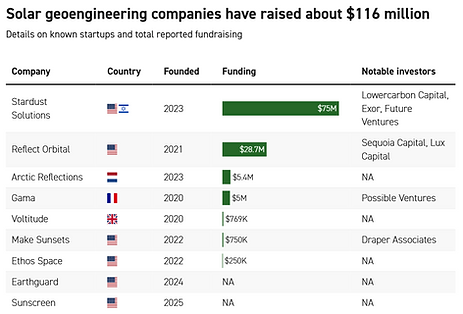
Investment firms have put over $100 million into developing risky technologies that could cool the planet with unknown side effects. Some business men are investing in new geoengineering technology. Venture capitalist Finn Murphy believes world leaders could soon resort to deflecting sunlight into space if the Earth gets unbearably hot. He has invested more than $1 million in Stardust Solutions, a leading solar geoengineering firm that’s developing a system to reduce warming by enveloping the globe in reflective particles. Feels a bit like "Project Hail Mary?"
Murphy is among a new wave of investors who are putting millions of dollars into emerging companies that aim to limit the amount of sunlight reaching the Earth — while also potentially destabilizing weather patterns, food supplies and global politics. Solar geoengineering investors are generally young, pragmatic and imaginative — and willing to lean into the adventurous side of venture capitalism. They often shrug off the concerns of scientists who argue it’s inherently risky to fund the development of potentially dangerous technologies through wealthy investors who could only profit if the planet-cooling systems are deployed.

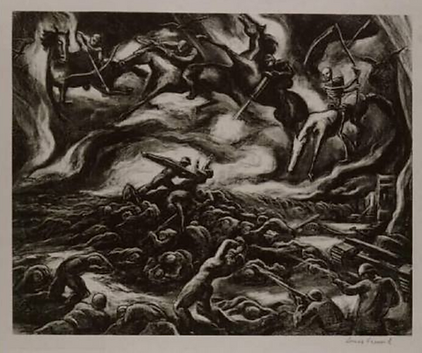
Harry Louis Freund | Four Horsemen of the Apocalypse (1946)
Four horsemen in the sky moving right to left above a torrid battle scene. Below, in the combat arena are piles of bodies and fighting and falling figures. To the right are tanks and guns. At center is a helmeted soldier bayoneting or impaling a male figure. Here instead of mythical or religious figures, man is at the center of the conflict.
Freund painted Four Horsemen of the Apocalypse in 1946, just one year after the end of World War II. He was part of a generation of American artists who had witnessed the war from the home front or through newsreels and photographs of the liberation of concentration camps.
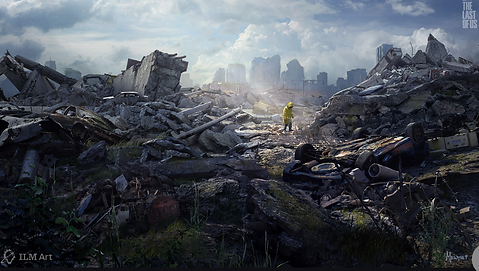
Saby Menyhei | The Last of Us: Season 1 Concept Art (2025)
Saby Menyhei is a UK-based freelance concept designer and digital illustrator known for his work in film, games, and sci-fi art. From a young age, he developed a passion for drawing and later explored computer graphics. Over his career, Meyhei has amassed an impressive portfolio in the entertainment industry. Check out Art of Saby Menyhei.
He has contributed to major films and series including: Gladiator 2, Blade (2024), Star Wars: The Acolyte, Percy Jackson and the Olympians, The Last of Us, Ant-Man and the Wasp: Quantumania, Avengers: Endgame, Love, Death and Robots, Pacific Rim: Uprising, and Rogue One. The artists behind The Last of Us emphasized realism and a departure from traditional "zombie" aesthetics to make the world feel authentic and lived-in. To achieve this, the art department looked at photos of natural disasters, war aftermaths, and real-world locations rather than other zombie films.

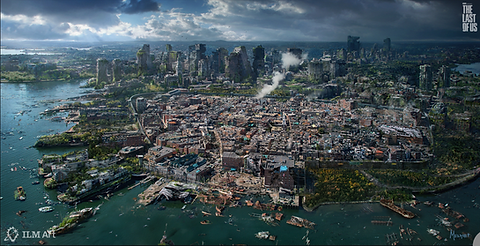
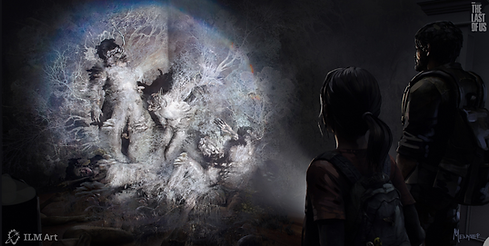
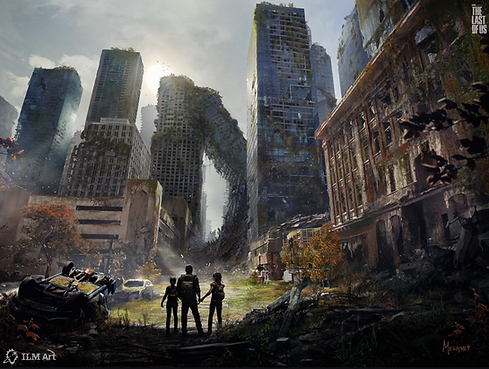
Kevin Sherwood & James McCawley | “Where Are We Going?” (2013)
The song serves as the musical embodiment of the Mob of the Dead cycle. It is sung from the perspective of the four mobsters—Albert "Weasel" Arlington, Salvatore "Sal" DeLuca, Michael "Finn" O'Leary, and Billy Handsome—who are trapped in Alcatraz, forced to relive their failed escape attempt and their violent deaths over and over again. Thematically, it is a song about eternal punishment, guilt, and the desperate search for redemption in a cycle that offers none. The song makes it clear that Alcatraz isn't just a prison; it is a manifestation of their sins.
The end of the world can have a soundtrack, too. Consider the musical selections below. What were the circumstances around each one’s creation, and what techniques do they use to achieve their messages and moods?
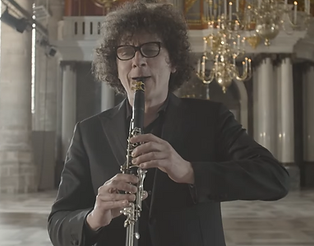
Olivier Messiaen | Quartet for the End of Time: “Abyss of the Birds” (1940)
In 1940, Messiaen was a French soldier captured by the German army during the fall of France. He was imprisoned in Stalag VIII-A, a prisoner-of-war camp in Görlitz, Germany (now Zgorzelec, Poland). The quartet was premiered on January 15, 1941, in the camp. The audience consisted of approximately 400 prisoners and guards. Messiaen had with him three fellow prisoners: a violinist, a cellist, and a clarinetist. Messiaen himself played the piano part. The title refers not to the "end of the world" in a catastrophic sense, but to the end of linear time—a reference to the Biblical Book of Revelation (10:6): "There shall be time no longer." Messiaen sought to transcend earthly time through music, evoking eternity.


Messiaen provided programmatic notes for each movement. Regarding this movement, he wrote: "The abyss is Time with its sadness, its weariness. The birds are the opposite of Time; they are our desire for light, for stars, for rainbows, and for jubilant songs."
A signature Messiaen technique appears throughout: non-retrogradable rhythms (palindromic rhythms). These are rhythmic patterns that read the same forwards and backwards. For Messiaen, this symbolized the suspension of time—a movement toward eternity, where past and future collapse into the present.
"Abyss of the Birds" remains one of the most important and challenging works for solo clarinet, studied and performed by clarinetists worldwide as a rite of passage.
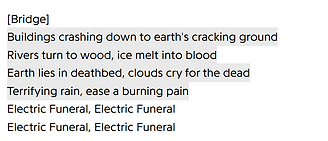
Black Sabbath | “Electric Funeral” (1970)
“Electric Funeral” is the fifth track on Black Sabbath’s landmark 1970 album, Paranoid. Written by the band—Ozzy Osbourne (vocals), Tony Iommi (guitar), Geezer Butler (bass), and Bill Ward (drums)—the song presents a bleak, dystopian vision of a post-nuclear world. With its slow, crushing guitar riffs, eerie vocals, and apocalyptic lyrics, it stands as one of the earliest and most influential examples of doom metal. The song describes the aftermath of nuclear war: radiation poisoning, robotic enslavement, cities reduced to ruins, and eternal damnation. It reflects the Cold War anxieties and anti-war sentiments prevalent in the late 1960s and early 1970s. The lyrics, primarily written by bassist Geezer Butler, serve as a stark warning against nuclear warfare and technological hubris. Butler drew inspiration from the Cold War climate and the Vietnam War, channeling widespread fears of global annihilation into visceral imagery.



REM | “It’s the End of the World as We Know It” (1987)
This dystopian anthem is by American rock band R.E.M., which first appeared on their 1987 album, Document. It was released as the album's second single. Written by all four band members—Michael Stipe (vocals), Peter Buck (guitar), Mike Mills (bass), and Bill Berry (drums)—the song is known for its frenetic pace, dense stream-of-consciousness lyrics, and ironically upbeat chorus.
One strange aspect of the song is the LB Dream and is one of the most famous section of the song lists four figures with the initials "L.B.": Leonard Bernstein (conductor), Leonid Brezhnev (Soviet leader), Lenny Bruce (comedian), and Lester Bangs (music journalist). Stipe revealed this came from a dream where he was the only person at a

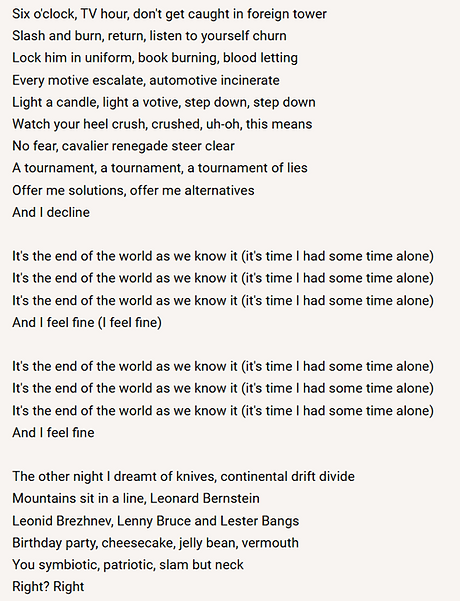
party whose initials weren't L.B.. This surreal image captures the song's blending of high culture (Bernstein), politics (Brezhnev), counterculture (Bruce), and rock criticism (Bangs).
The core paradox of the song lies in its title and chorus: "It's the end of the world as we know it, and I feel fine." This can be interpreted in several ways. It may represent a state of numbness, where people have become so desensitized to constant doomsday warnings that they no longer react with fear. Alternatively, it can be read as a defiant statement of resilience—even in the face of societal collapse, one can find a sense of liberation or personal peace. The repeated parenthetical line, "It's time I had some time alone," suggests a weary individual finally finding a moment of quiet amidst the chaos

Chaos, then catastrophe. Researchers have found that one of the signs that an ecosystem is about to collapse is that things become more volatile—for instance, the amount of chlorophyll in a lake rapidly spikes and plunges. Global climate change is causing something similar: extreme weather events like hurricanes and droughts have grown more frequent. Even flights are facing more turbulence. Discuss with your team: what should we do if the climate passes a point of no return? Would it be okay to spend fewer resources on fighting climate change if the battle is already lost?
Cary Institute limnologist Jonathan Cole was part of a research team that was the first to reveal how variability in key ecosystem processes can help scientists identify the early warning signs of ecosystem collapse. Their paper was published in the journal Science. For scholars that enjoy environmental science, this is a great article.
"Early warning signs help you prepare for, and hopefully prevent, the worst case scenario," notes Cole. "We are surrounded by problems caused by ecological regime shifts—from water supply shortages to fishery declines; our study shows that we can identify these changes before they reach their tipping point."
In a large field experiment, the team triggered a regime shift in a freshwater lake by introducing bass. The study lake was originally dominated by small fish that feed on tiny free-swimming invertebrates. Their goal was to destabilize the lake and observe the changes that led to a food web dominated by predatory fish.
As bass numbers increased, smaller fish spent more time swimming in groups near the shoreline to avoid being eaten. Freed from predation, open water invertebrates shifted to forms that were larger in size. Phytoplankton, the tiny plants that are a dietary staple of these invertebrates, became more variable. Within three years, the lake's food web had completely shifted to one dominated by large fish-eating fish and larger free-swimming invertebrates.
Throughout the lake's manipulation, a buoy was used to record chemical, biological, and physical vital signs, noting even the smallest changes. Manual samples were also taken daily. By analyzing these massive sets of data, the team was able to detect that an ecosystem shift was looming. More than a year before the food web transition was complete, variance in chlorophyll—the green pigment found in plants and algae—was a reliable indicator of the impending food web shift. The study is the first time that an early warning sign for ecosystem collapse has been validated in the field. If similar signs could be identified in other types of ecosystems, it would revolutionize environmental management. The chlorophyll "red flag" would only help identify food web shifts in freshwater lakes and not practical for every ecosystem, but once initiated regime shifts can be difficult to reverse.
More than 50 financial firms, wealthy individuals and government agencies have collectively provided more than $115.8 million to nine startups whose technology could be used to limit sunlight. That pool of funders includes Silicon Valley’s Sequoia Capital, one of the world’s largest venture capital firms, and four other investment groups that have more than $1 billion of assets under management. Of the total amount invested in the geoengineering sector, $75 million went to Stardust, or nearly 65 percent. The U.S.-Israeli startup is developing reflective particles and the means to spray and monitor them in the stratosphere, some 11 miles above the planet’s surface.
The cash infusion is a bet on planet-cooling technologies that many political leaders, investors and environmentalists still consider taboo. In addition to having unknown side effects, solar geoengineering could expose the planet to what scientists call “termination shock,” a scenario in which global temperatures soar if the cooling technologies fail or are suddenly abandoned. Investment wise, unless there is a stable client who pay for deployment of "star-dust" on the long-run, there is no viable business.


One startup is pursuing space-based solar geoengineering. EarthGuard is attempting to build a series of large sunlight deflectors that would be positioned between the sun and the planet, some 932,000 miles from the Earth. Other space companies are considering geoengineering as a side project. That includes Gama, a French startup that’s designing massive solar sails that could be used for deep space travel or as a planetary sunshade, and Ethos Space, a Los Angeles company with plans to industrialize the moon.
Sequoia-backed Reflect Orbital is another space startup that’s exploring solar geoengineering as a potential moneymaker. The company based near Los Angeles is developing a network of satellite mirrors that would direct sunlight down to the Earth at night for lighting industrial sites or, eventually, producing solar energy. Its space mirrors, if oriented differently, could also be used for limiting the amount of sun rays that reach the planet. Reflect Orbital has raised nearly $28.7 million from investors including Lux Capital, a firm that touts its efforts to “turn sci-fi into sci-fact”. SpaceX CEO Elon Musk, whose aerospace company already has an estimated fleet of more than 8,800 internet satellites in orbit, has also suggested using the circling network to limit sunlight. “A large solar-powered AI satellite constellation would be able to prevent global warming by making tiny adjustments in how much solar energy reached Earth,” Musk wrote on X last month.
Other interesting projects include Arctic Reflections, a two-year-old company that wants to reduce global warming by increasing Arctic sea ice, which doesn’t absorb as much heat as open water. Another one is Sunscreen, a new startup that is trying to limit sunlight in localized areas. It was founded earlier this year by Stanford University graduate student Solomon Kim. “We are pioneering the use of targeted, precision interventions to mitigate the destructive impacts of heatwave on critical United States infrastructure,” Kim said in an email. But he was emphatic that “we are not geoengineering” since the cooling impacts it’s pursuing are not large scale.
Since ancient times, the end of the world has been an obsession that men have tried to cope with, understanding it through religion and philosophy, reflecting upon it through art and writing. Powerful men have tried to find solutions and scoundrels have manipulated men's fears. In the last century, technology has given men the power to harness the resources of earth and transformed the way we live. We have vanquished diseases, somewhat settled nuclear threats, and continue to strive to reduce the ceilings of poverty, education, and discrimination. Nevertheless, men have never faced a more dire existential challenge and worthy adversary than climate change. History provide clues but no direct answers. This is the ultimate question for our generation, and there is unlikely to be an easy answer of equality with minimal sacrifice on all our parts. Before we take to space, let's give this planet our best try.
- Maurizio & Penelope