
Where We’re Going, We’ll Still Need Them

“All roads lead to Rome,” insisted one medieval European proverb. (In other parts of the world, roads led elsewhere.) While Roman roads may be the most famous for their longevity and scale, they were far from the first road network. Explore the history of roads and the related terms below. Then, consider some of the most famous roads in the world both today and in ancient times.
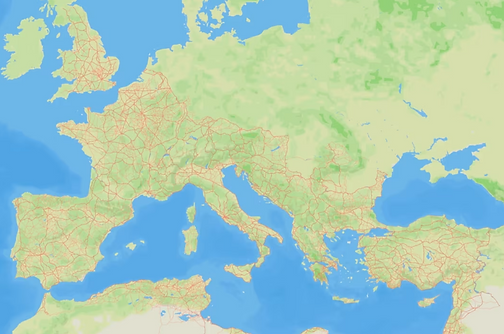
At the height of its power in the second century A.D., the Roman Empire was the largest the world had ever known. More than 55 million people lived within its borders, stretching from modern-day Britain, Spain and Germany to northern Africa, the Middle East and Asia Minor. The Roman Empire reached its greatest extent in A.D. 117 under Emperor Trajan, who ruled over a territory of nearly 2 million square miles.
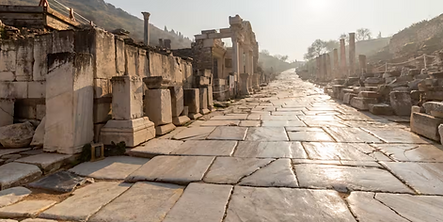
Even more remarkable than its sheer size, however, was that each far-flung province of the Roman Empire was connected by a vast network of roads. The bigger Roman roads have received so much attention because they’re among the engineering marvels of the ancient world. The Via Augusta, for example, was constructed by Rome’s first emperor, Octavian (also known as Augustus), between 8 and 2 B.C. The wide, paved highway ran more than 900 miles across the length of ancient Hispania (modern Spain) from the Atlantic port city of Cadiz to the Pyrenees Mountains, where it connected to Italy.
Roman engineers used surveying tools like the Dioptra and the Groma to lay out orderly city grids and construct the long, mostly straight roads connecting imperial outposts. The Romans also installed milestones along major roads like the Via Augusta, each inscribed with the distance to the nearest city or way station. More than 8,000 Roman milestones have been found with Latin inscriptions.
But according to research published in November 2025 by Brughmans and his colleagues in Spain, the full extent of the Roman road network went far beyond those major thoroughfares. By cross-referencing archaeological and historical records with topographic maps and satellite imagery, the team identified more than 60,000 new miles of Roman roads, most of them unpaved secondary roads. The findings raise estimates of the extent of the Roman road network to 185,896 miles across almost 1,544,409 square miles.
“In a desert, a ‘Roman road’ is a wide lane, perhaps with some milestones along the side,” says Brughmans. “They


also constructed way stations—Roman forts where travelers could replenish their supplies, exchange their camel or take shelter from a sandstorm.”
If a “Roman road” is any road used by Roman citizens, then that definition includes everything from a paved two-lane road passing through a major city to a dirt path winding through an olive grove. Brughmans hopes other scholars will use the digital atlas of ancient Roman roads to explore how this unprecedented physical network changed history.
Since the popularity of automobiles in the 20th century, cars have been essential for any family holiday. Here are 12 of the most famous roads to drive around the world.

1. Lombard Street, San Francisco, USA - 8 hairpin twists down the hills

2. Abbey Road, London, UK -Home to the legendary Abbey Road Studios where the Beatles recorded all of their albums. Location of the Beatles famous cover.

3. Broadway - most famous for the ten or so blocks between 42nd and 53rd streets, aka the Theatre District.

4. Champs-Elysees, Paris, France - With the Arc de Triomphe at one end, the Place de la Concord at the other

5. Hollywood Boulevard, Los Angeles, USA - embedded with over 2,500 five-pointed stars bearing the names of the Hollywood elite. The first permanent star being created on March 28, 1960, for director Stanley Kramer.


6. Lan Kwai Fong, Hong Kong - Famed for its night life, award-winning dining, and more than 80 restaurants and bars

7. White Rim Road, Canyonlands National Park, Utah, USA -The 100-mile White Rim Road loops around and below the Island mesa top and provides expansive views of the surrounding area.

9. Stelvio Pass, Eastern Alps, Italy - Top Gear once named the “greatest driving road in the world.”
8. Tianmen Mountain Road, Hunan, China - An 11km road with 99 bends reaches the top of the mountain, taking visitors to Tianmen cave, a natural hole in the mountain 131.5 metres up.

10. Guoliang Tunnel Road, China - Stretching 1.2 kilometres long, it took five years to build by just 13 villagers, to connect the small village of Guoliang to the rest of the world.

11. Amalfi Coast, Italy - picturesque coastal towns including Positano and Ravello, the Amalfi Coast is home to SS163, a snaking two-lane road that hugs the jagged hills that meet the sparkling Tyrrhenian Sea.

12. Route 66, USA - This 2,400-mile stretch of road from Chicago to Santa Monica is one of America’s oldest and most famous highways. Also called ‘the Main Street of America’, it passes through eight states – Illinois, Missouri, Kansas, Oklahoma, Texas, New Mexico, Arizona, and California.
We often think of roads as just ways to get from one place to another. But some roads have done much more than that. They carried armies, ideas, goods, and faith across vast lands. They connected ancient kingdoms and modern nations. These roads have seen everything from conquests and pilgrimages to trade caravans and revolutions. In a way, they have been silent witnesses to the rise and fall of civilizations.

The Silk Road: More Than Just Trade
The Silk Road was not one single road but a huge network of trade routes that stretched from China all the way to Europe and North Africa. It started around 130 BCE during the Han Dynasty and stayed active for over 1,500 years. Along this road, silk was indeed a famous item, but so were spices, gold, porcelain, paper, and even horses. More importantly, ideas and religions traveled this way too. Buddhism spread from India to China through the Silk Road. So did Christianity, Islam, and other beliefs.
The Roman Roads: Engineering Wonders That Last
“All roads lead to Rome.” That saying came from a time when it was actually true. At its peak, the Roman Empire built over 400,000 kilometers of roads. About 80,000 of those were paved with stone. These roads connected Rome to the farthest edges of the empire. Britain, Gaul, Spain, Greece, and North Africa were all linked.
The Royal Road of Persia: A Masterstroke of the Achaemenids
Built during the reign of Darius the Great in the 5th century BCE, this road stretched about 2,700 kilometers. It ran from Sardis near the Aegean Sea to Susa in modern-day Iran. What made the Royal Road so special was its speed. Couriers could cover the entire length in just nine days, thanks to relay stations and fresh horses. That was extremely fast for the time. This allowed messages to travel quickly across the empire, helping rulers maintain control over far-off provinces.
The Inca Road System: Empire in the Clouds
The Inca people of South America created more than 40,000 kilometers of roads. These roads connected Cusco, the capital of the Inca Empire, to places as far north as Colombia and as far south as Chile. What made these roads remarkable was the terrain. The Incas built roads through mountains, across deserts, and over rivers. They used hanging rope bridges to cross canyons. They carved paths into cliffs. They built stairways up steep slopes. The most famous road is the one that leads to Machu Picchu. It is now known as the Inca Trail.
The Amber Road: The Northern Path of Wealth
This fossilized tree resin was used for jewelry, medicine, and even religious items. The Amber Road was the network that carried this precious material from the Baltic Sea to the Mediterranean. It passed through modern-day Poland, Germany, Austria, and down to Italy and Greece. Greek and Roman traders loved Baltic amber and were willing to pay high prices for it. Though not as famous as the Silk Road, the Amber Road helped connect northern and southern Europe.


The King’s Highway: A Sacred and Strategic Route
This road is one of the oldest continuously used routes in the world. The King’s Highway ran from Egypt across the Sinai Peninsula through Jordan and into Syria. It was first used in the Bronze Age and became more famous during the time of the biblical kingdoms.
The Grand Trunk Road: The Lifeline of South Asia
In the Indian subcontinent, the Grand Trunk Road has been a vital highway for centuries. It stretches over 2,500 kilometers from Bangladesh to Afghanistan, passing through India and Pakistan.
The road was first developed in the Mauryan Empire around the 3rd century BCE. But it was later improved by Sher Shah Suri, a ruler in the 16th century. He added inns, wells, and trees to shade travelers.


The Via Francigena: A Spiritual Road Across Europe
One of the most famous pilgrimage routes was the Via Francigena. This road connected Canterbury in England to Rome in Italy. Pilgrims walked for months across France and the Alps to reach the holy city. Along the way, they passed through small towns, monasteries, and churches. It was a journey of both faith and endurance.
The Trail of Tears: A Road of Sorrow
In the 1830s, the United States forced thousands of Native Americans, mainly from the Cherokee Nation, to leave their homelands in the southeast and walk to what is now Oklahoma. This forced march is now known as the Trail of Tears. It covered over 1,600 kilometers and resulted in the deaths of thousands due to cold, hunger, and disease.
The Ho Chi Minh Trail: The Road Through the Jungle
During the Vietnam War, the Ho Chi Minh Trail became one of the most strategic routes in the world. It was a network of jungle paths that ran from North Vietnam to South Vietnam through Laos and Cambodia. The trail was used to move soldiers, weapons, and supplies. It was heavily bombed by American forces, but it kept functioning through sheer willpower and ingenuity.


Macadam is a type of road construction pioneered by Scottish engineer John Loudon McAdam c. 1820, in which crushed stone is placed in shallow, convex layers and compacted thoroughly. A binding layer of stone dust (crushed stone from the original material) may form; it may also, after rolling, be covered with a cement or bituminous binder to keep dust and stones together. The method simplified what had been considered state-of-the-art at that point. McAdam realized the roadbed itself—not a thick, deep foundation of heavy rock—could support the weight if it was well-drained. His roads were raised slightly (crowned) to shed water into side drains.
Today, it's the technical ancestor of almost every paved road. Early macadam created dust and required constant maintenance. Around 1900, Edgar Purnell Hooley patented tarmacadam: spraying hot tar (or bitumen) over the stone surface and mixing it with sand, then rolling it. This bound the stones, reduced dust, and created a waterproof, smoother road. The short name tarmac stuck. Modern "macadam" usually means tarmac (tar + crushed stone), which is the precursor to asphalt concrete.

Pavement is the general term for any durable surface laid over ground to support traffic. So all the different types of paved roads are called pavement. The first paved streets appear to have been built in Ur in 4000 BC. Brick-paved roads were built in the Indus Valley Civilisation. The first professional road builder to emerge during the Industrial Revolution was John Metcalf, who constructed about 290 kilometres (180 mi) of turnpike road, mainly in the north of England, from 1765.
Wheeled transport created the need for better roads. Generally, natural materials cannot be both soft enough to form well-graded surfaces and strong enough to bear wheeled vehicles, especially when wet, and stay intact. In urban areas it was worthwhile to build stone-paved streets. Pavements are crucial to countries such as United States and Canada, which heavily depend on road transportation.

Asphalt concrete (commonly called asphalt, blacktop, or pavement in North America, and tarmac, bitmac or bitumen macadam in the United Kingdom and Ireland) is a composite material commonly used to surface roads, parking lots, airports, and the core of embankment dams. Asphalt mixtures have been used in pavement construction since the nineteenth century. It consists of mineral aggregate bound together with bitumen (a substance also independently known as asphalt, pitch, or tar), laid in layers, and compacted.

As shown in this cross-section, many older roadways are smoothed by applying a thin layer of asphalt concrete to the existing Portland cement concrete, creating a composite pavement.

Natural asphalt has been known of and used since antiquity, in Mesopotamia, Babylon, Greece, Carthage and Rome to waterproof temple baths, reservoirs, aqueducts, tunnels, and moats, as a masonry mortar, to cork vessels, and surface roads. Later man-made concrete was created. It's called "concrete" because, like traditional cement concrete (cement + water + aggregate), it's a man-made composite of aggregate bound together by a binder. The binder here is asphalt, not cement.
Sheet asphalt placed on a concrete base (foundation) became popular during the mid-1800s with the first one of this type being built in Paris in 1858. The first such pavement placed in the U.S. was in Newark, New Jersey, in 1870.
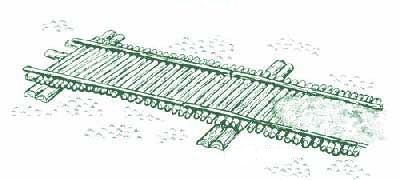
A corduroy road or log road is a type of road or timber trackway made by placing logs, perpendicular to the direction of the road over a low or swampy area. Over swamps, marshes, mudflats, or very soft soil where a normal road would sink. This is an improvement from mud or dirt roads. However, they are still rough in the best of conditions, and the shifting logs can pose a hazard for horses. In World War II corduroyed roads were used by both German and Soviet forces on the Eastern Front.
The historical Gallery Roads (simplified Chinese: 栈道; traditional Chinese: 棧道), also known as Cliff Roads or Plank Roads, were routes traversing remote mountainous regions of China. The roads were fashioned using wooden planks securely fastened within holes carved into cliff sides. Primarily found in the Qin Mountains, they connected the Wei River and the Han River valleys. The first gallery roads were built during the Warring States period (476–221 BC) and used by Qin to invade Shu and Ba.

Gallery roads were predominantly constructed to ease transportive strain across cliffs in rugged mountainous areas. One example is the Shu Road, which runs through some of China's most rugged and desolate terrains such as the Qinling and Daba Mountain ranges, to link the Wei River valley and the ancient capital of Chang'an, It used the plank road technique to secure pathways across cliffs and steep ravines. Modern reconstructions of gallery roads use more durable materials like steel and stone. Some sections have glass components intended to attract tourists.
A Holloway (or sunken lane) is an ancient road or track that has been worn down over centuries—sometimes hundreds of years—so that it now sits significantly lower than the land on either side, almost like a natural tunnel carved into the earth. Holloways may have been formed in various ways, including erosion by water or traffic; the digging of embankments to assist with the herding of livestock; and the digging of double banks to mark the boundaries of estates.

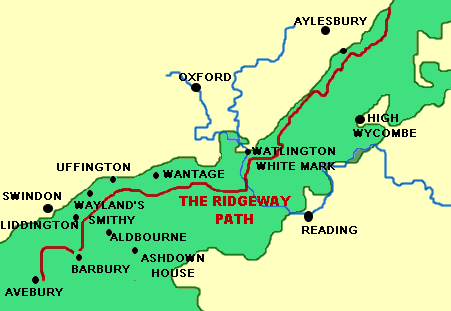

A Ridgeway is a type of ancient path or road that follows the crest of a ridge—the high ground along the top of a hill or mountain. It represents the oldest form of "road" in the British landscape. A ridgeway is defined by its elevated position. It runs along the top of a chalk ridge or escarpment, staying on the high, exposed crest. Ridgeways were not "built" in the engineered sense. They are unpaved trackways that formed naturally over centuries as people and animals repeatedly took the same path of least resistance across the high ground. In ancient times, the valleys below were covered in dense, dark, and dangerous forests filled with wild animals and bandits. The high ridges were easier to see for travel and you can spot potential enemies from far away. The Ridgeway (capital "T") refers to a specific, famous National Trail in Southern England.
Milestone is a numbered marker placed on a route such as a road, railway line, canal or boundary. They can indicate the distance to towns, cities, and other places or landmarks like mileage signs; or they can give their position on the route relative to some datum location. Milestones are installed to provide linear referencing points along the road. This can be used to reassure travellers that the proper path is being followed, and to indicate either distance travelled or the remaining distance to a destination, in ancient times, it could be a pilgrimage site or city.
Miliarium were originally stone obelisks – made from granite, marble, or whatever local stone was available – and later concrete posts. They were widely used by Roman Empire road builders and were an important part of any Roman road network.
In the 1700s, frustrated by the abysmal state of the country's roads, Parliament took action. Rob Westlake, chairman of The Milestone Society, said: "Most of the byways and highways, routes between places of commerce, were absolutely in a disastrous state - in winter some were impassable, in summer they were dry and dusty and unpleasant, but it was the only method for passengers and cargoes to travel."
Turnpike trusts were introduced, each one by a separate Act of Parliament, across the country to take on the upkeep of key roads. In most cases, to fund the turnpikes - the motorways of their day - tolls were needed, with permanent waymarkers installed to prevent disputes over distances travelled and how much coaches needed to be paid.


A trackway is a route or path formed by the repeated traversal of people, animals, or vehicles, often across undeveloped land. It is the most fundamental and ancient form of human-made road. One historic example would be the The Sweet Track, a 5830-year-old Neolithic timber walkway, located in the Somerset Levels in England and discovered in 1970. It was originally part of a network of tracks built to provide a dry path across the marshy ground.
.jpg)
Modern engineering is moving towards roads that do more than just sit on the ground—they participate actively in transport. As you explore the innovations below, consider: what problems are they trying to solve, and what new ethical or environmental problems might they create? Ultimately, is the future of the road paved at all, or does something more radical await over the horizon?
Solar Roadways Incorporated is an American company based in Sandpoint, Idaho, aiming to develop solar-powered road panels to form a smart highway. Their proof-of-concept technology is a hexagonal road panel that has a glass driving surface with underlying solar cells, electronics, and sensors to act as a part of solar array with programmable capability. The concept has been widely criticized as unfeasible and uneconomical as either a road surface or a photovoltaic system. These panels could have built in LEDs and heating elements to display road markings and messages, as well as to melt snow and ice while running from the electricity they generate themselves.
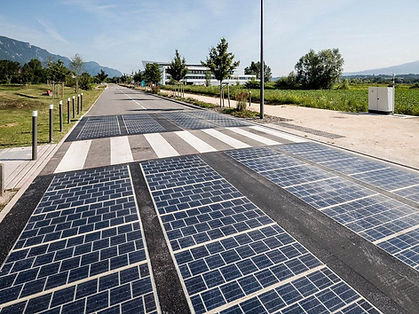
This idea is being tested by many companies. Test solar powered roads have been built in several countries (France, Netherlands, China, USA) all with slightly different systems. Unfortunately, none have been successful in producing electricity and providing a safe road surface so far.
Some challenges:
-
Durability – Solar panels are delicate and all of the solar powered roads tested broke very quickly.
-
Cost – Solar roads are far more expensive than building normal roads with solar panels next to them.
-
Slippy – solar panels are smooth but roads need to be textured to provide grip for vehicles and avoid accidents.
-
Inefficient – normal solar panels are angled towards the sun and have a very thin glass coating to maximise the amount of light going into the panel. Solar roads are flat on the ground and have very thick glass to protect the delicate electronics, this means much less light can get into the panel.
-
Shade – Many roads are shaded by building or trees for all or part of the day and are often covered by other things such as leaves, dust, and vehicles.
In 2014, Jonathan Levine, a professor of urban planning at the University of Michigan, expressed doubt regarding the political feasibility of the project on a national scale. He suggested, however, that a single town might be able to deploy the concept in a limited test case such as a parking lot. Journalist David Biello, writing in Scientific American in July 2014, noted the difficulties of the project in dealing with material limitations, particularly in its choice of making the surface of the panels from glass, which "must be tempered, self-cleaning, and capable of transmitting light to the PV below under trying conditions, among other characteristics—a type of glass that does not yet exist." Sebastian Anthony noted in ExtremeTech in May 2014 that the cost to replace all roads in the United States with Solar Roadways panels would come to approximately $56 trillion.


Piezoelectric materials are materials that generate an electric charge when subjected to mechanical stress or pressure. These materials can convert kinetic energy—like the weight of a vehicle driving over a road—into electrical energy. When incorporated into pavement systems, these materials can capture the energy created by the constant motion of traffic and use it to generate power.
Piezoelectric pavement involves embedding piezoelectric crystals or devices within the road surface, typically beneath the asphalt. As vehicles pass over the pavement, their weight and movement cause the piezoelectric devices to deform, generating electricity. This electricity can then be used to power streetlights, traffic signals, or even nearby infrastructure.
The movement of vehicles, such as cars, trucks, and buses, creates pressure on the road surface. This pressure causes the embedded piezoelectric devices to deform or vibrate, which generates an electrical charge. The energy generated from the mechanical stress is captured by the piezoelectric devices. These devices are connected to an electrical circuit, allowing the captured energy to be stored or used immediately. The electricity generated by piezoelectric pavement can be used to power nearby infrastructure, such as streetlights, traffic signals, or even public charging stations for electric vehicles (EVs). In some cases, excess energy can be stored in batteries or fed into the local grid.
One of the most promising applications of piezoelectric pavement is in powering streetlights and traffic signals. These systems require a constant power supply, and piezoelectric pavement can provide a reliable source of energy without the need for external electricity.
.jpg)
One of the most promising applications of piezoelectric pavement is in powering streetlights and traffic signals. These systems require a constant power supply, and piezoelectric pavement can provide a reliable source of energy without the need for external electricity. Unlike a solar roadway that generates power from light or a piezoelectric system that harvests energy from weight, an inductive charging road transfers high-voltage power directly to moving vehicles, turning the pavement into a wireless charging pad.
When an EV equipped with a receiver passes over the energized road coils, electricity jumps across the air gap (and through the pavement material) without any physical connection. It's the same principle as a wireless phone charger—scaled up by a factor of 10,000 times or more.
There are two types static charge and dynamic charge. Static charge is charging while parked. The vehicle stops over a charging pad (e.g., in a garage or at a traffic light). Dynamic charge is when charging while driving at highway speeds. Coils are embedded in the road surface.
Inductive charging roads are no longer theoretical. In 2025, France and the United States both successfully demonstrated dynamic wireless charging on public highways at full highway speeds, delivering power comparable to the fastest Superchargers.

DCRC
DSRC (Dedicated Short-Range Communications) is a wireless communication technology designed specifically for vehicles to talk to each other and to the road itself — not for entertainment, but for split-second safety decisions.
-
V2V (Vehicle-to-Vehicle): Your car tells nearby cars "I am here, going this speed, braking hard." Their cars calculate collision risk and alert their drivers — even if you're around a blind corner .
-
V2I (Vehicle-to-Infrastructure): A traffic light broadcasts "I will turn red in 5 seconds." Your car calculates whether you can make it or should start braking. A roadside weather sensor detects black ice and broadcasts "Slippery road ahead — reduce speed" .
-
V2P (Vehicle-to-Pedestrian): A pedestrian's smartphone (or a cyclist's tag) broadcasts their location. Your car warns you they're about to step into the crosswalk, even if you can't see them behind a parked truck
Other applications include:
-
Emergency warning system for vehicles
-
Cooperative Adaptive Cruise Control
-
Cooperative Forward Collision Warning
-
Intersection collision avoidance
-
Approaching emergency vehicle warning (Blue Waves)
-
Vehicle safety inspection
-
Emergency vehicle signal preemption
-
Electronic parking payments
-
Commercial vehicle clearance and safety inspections
-
In-vehicle signing
-
Rollover warning
-
Probe data collection
-
Highway-rail intersection warning
-
Electronic toll collection
Self-healing concrete is concrete able to fix its cracks on its own. It not only seals the cracks but also partially or entirely recovers the mechanical properties of the structural elements. This kind of concrete is also known as self-repairing concrete. The ancient Romans used a type of lime mortar that has been found to be self-healing.
Because concrete has a poor tensile strength compared to other building materials, it often develops cracks in the surface. These cracks reduce the durability of the concrete because they facilitate the flow of liquids and gases that may contain harmful compounds. If microcracks expand and reach the reinforcement, not only will the concrete itself be susceptible to attack, so will the reinforcement steel bars. Therefore, it is essential to limit the crack's width and repair it as quickly as feasible. Self-healing concrete would make the material more sustainable, and also contribute to an increase in the service life of concrete structures and make the material more durable and environmentally friendly.


There are three primary technological pathways to achieving self-healing in asphalt pavements.
Induction Heating: Ferromagnetic materials (steel wool fibers, steel slag) are mixed into the asphalt. An external induction coil passes over the road, heating these materials via electromagnetic currents, which softens the bitumen, allowing it to flow into and seal cracks.
Microwave Heating: Similar principle to induction, but uses microwave radiation to heat specific absorbing materials (like carbonyl iron powder or bio-based coatings) embedded in the asphalt.
Chemical Self-Healing: Uses reversible chemical bonds within the asphalt binder itself. When a crack forms, these bonds (like disulfide bonds) can break and then reform at the molecular level, closing the damage without external energy.
Bio-Spore Technology: Porous, recycled spores (microscopic capsules) are filled with a "rejuvenator" oil and mixed into the asphalt. When a crack forms, the spores rupture, releasing the oil to soften and heal the surrounding bitumen.
modular pavement
Modular pavement is an innovative construction technology where roads and surfaces are built using prefabricated, factory-made units (typically concrete slabs or interlocking blocks) rather than being cast or paved entirely on-site. Unlike traditional asphalt or poured concrete, which requires time for curing and is highly susceptible to weather, modular systems are designed for rapid installation and immediate use.


Modular paving falls into one of two categories: bound and unbound. Bound modular paving is laid down and then a mortar is used to cement them in place; the paving modules will not be able to move once the mortar has set. Unbound modular paving uses an aggregate, such as sand or gravel, between the joints. This means that the paving modules are able to flex and move just a bit, such as when a vehicle is traveling over them. This gives unbound modular paving a wealth of benefits.
Challenges modular pavement include ensuring the joints between slabs remain perfectly level (no "stepping") and transfer load effectively is a complex engineering challenge. The specialized molds and factory production often result in higher upfront material costs compared to traditional asphalt. Transporting large, heavy concrete slabs from the factory to the job site requires specific permits and heavy lifting equipment.
Engineers are working on integrating "smart road" technology into modular pavements. Concepts include embedding wireless charging coils for electric vehicles, fiber optics for weight detection, and heating elements into the precast slabs at the factory.
permeable pavement
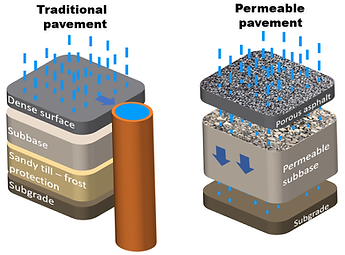
Permeable or porous pavement allows water to soak through the surface rather than flow over the surface and into storm drains. This system provides the structural support of conventional pavement but also has an underground stone reservoir. Permeable paving can also include a variety of surfacing techniques for roads, parking lots, and pedestrian walkways. Permeable pavement surfaces may be composed of pervious concrete, porous asphalt, paving stones, or interlocking pavers. In addition to reducing surface runoff, permeable paving systems can trap suspended solids, thereby filtering pollutants from stormwater.
Benefits of permeable pavement:
-
Stormwater reduction – Eliminates or reduces need for detention ponds and storm sewers. Can capture 70–90% of annual rainfall.
-
Pollutant filtration – Removes suspended solids, heavy metals, oil, and grease. Some nutrient removal (phosphorus) with proper design.
-
Groundwater recharge – Restores natural hydrology in developed areas.
-
Reduced heat island effect – Light-colored surface and evaporative cooling keep it cooler than asphalt.
-
Reduced infrastructure costs – May eliminate curbs, gutters, and piping on a site.

Disadvantages of permeable pavement:
-
Clogging – Fine sediment, sand, and debris can seal the surface over time. Requires regular maintenance (vacuum sweeping 1–2 times per year).
-
Not for high-sediment areas – Construction sites, unpaved shoulders, or heavy leaf fall areas cause rapid clogging.
-
Limited to low-speed traffic – Not suitable for highways or high-speed roads (typically ≤ 40 mph).
-
Poor subgrade conditions – Requires well-draining soils (minimum infiltration rate ~0.5 in/hr). Clay soils may need underdrains and still have reduced performance.
-
Cold climate concerns – Freeze-thaw cycles can cause damage, but proper design (depth below frost line, no fines in base) has been successful in northern climates.
-
Higher initial cost – Typically 10–50% more expensive than conventional pavement, though life-cycle costs may be lower when stormwater infrastructure is avoided.
Urban designers know the frustration of watching unofficial trails sprout on perfectly manicured lawns. These are desire paths: the physical evidence of the shortest distance between two points. But, while a straight line is efficient, it isn’t always optimal. The “best” route is a shifting balance of speed, energy, and the unknown. With your team, consider the logic of the shortcut and the science of the scenic route. How do humans, animals, and even slime molds decide what way to go? Should we always follow the path of least resistance?
When cities lack the paths pedestrians need, people vote with their feet. Desire paths have been described as illustrating “the tension between the native and the built environment and our relationship to them”. Because they often form in areas where there are no pavements, they can be seen to “indicate [the] yearning” of those wishing to walk, a way for “city dwellers to ‘write back’ to city planners, giving feedback with their feet”. There are many slang to describe “free-will ways”, including “cow paths, pirate paths, social trails, kemonomichi (beast trails), chemins de l’âne (donkey paths), and Olifantenpad (elephant trails)”.

But as well as revealing the path of least resistance, a sort of civil disobedience. Rather than dismiss or even chastise the naughty pedestrian by placing fences or railings to block off “illicit” wanderings, some planners work to incorporate them into urban environments. Architect and urban planner Riccardo Marini takes desire lines very seriously. Desire paths are about “listening to a place” – and listen Marini does: he has even drawn up bubblegum and cigarette butt maps of Regent Street in London to help inform where to place benches.

Michigan State University didn’t put in pavements when new buildings were created. Instead, it waited for students to create their own paths.
In the 90s, the Dutch architect Rem Koolhaas spearheaded one of the best-known examples, letting the footfall of students inform his plan for the Illinois Institute of Technology. Hospitals, too, have been known to respond to organically produced footpaths: at the US National Institutes of Health, the footpaths that developed in the 1960s, 70s and early 80s went on to be paved. There is historical precedent, too. According to some urban planning experts, Broadway was New York City’s earliest desire line, following as it does the Native American-made Wickquasgeck Path, which is thought to have been the shortest route between pre-colonial settlements in Manhattan that avoided swamps and hills. Broadway is the only remaining one path, according to Marini, that “wasn’t wiped out by the European grid being overlaid on it”.
In a heavily constructed city, there are “rules as to how public and public-private spaces are used”, he says. Desire paths are about “not following the script” – he calls it a “resistance”.

In the theory of computational complexity, the travelling salesman problem (TSP) asks the following question: "Given a list of cities and the distances between each pair of cities, what is the shortest possible route that visits each city exactly once and returns to the origin city?" Despite its simple statement, TSP is an NP-hard problem, meaning that no algorithm can solve all instances efficiently (in polynomial time) unless P = NP, which is widely believed to be false.
The problem was first formulated in 1930 and is one of the most intensively studied problems in optimization. It is used as a benchmark for many optimization methods. The difficulty lies in the combinatorial explosion of possible routes. For just 20 cities, checking every possible route on the fastest supercomputer would take longer than the age of the universe.
This seemingly simple or hard problem has many modern application from direct routes for logistics, to military planning, manufacturing to genetic sequencing.
vector-based navigation
Vector-based navigation is a navigation strategy that relies on a mental "arrow" or direction vector pointing directly toward a destination, rather than calculating the absolute shortest geometric path. It's a core mechanism used by both biological brains (from insects to humans) and artificial intelligence systems. The simplest way to understand vector-based navigation is this: instead of calculating the shortest route, you choose the path that points most directly toward your destination at each decision point.
This is fundamentally different from how your GPS works. A smartphone can calculate the mathematically shortest route because it has a complete map loaded into memory. Biological brains—and many AI systems—don't have that luxury, so they use a computationally cheaper "good enough" strategy.
At the core of insect vector navigation is a process called path integration (also known as "dead reckoning") Researchers discovered that pedestrians don't take the shortest routes. Instead, they choose the "pointiest path" —routes that minimize the angle between their current direction and the straight line to their destination. This method works even with incomplete knowledge of the environment. Our direction‑sensitive place cells form vector fields pointing to goals.

The explore–exploit problem is the fundamental decision‑making dilemma of choosing between using what you already know (exploit) and trying something new to gain information (explore). It appears in psychology, economics, neuroscience, and especially reinforcement learning. This balance is essential because exploiting too early can trap you in a local maximum, while exploring too much prevents you from benefiting from what you’ve learned. The dilemma is that you
cannot do both at the same time. Every moment spent exploring is a moment not exploiting known rewards. But without exploration, you may never discover that a better option exists.
The classic formalization of the explore-exploit problem is the multi-armed bandit (named after the "one-armed bandit" slot machine). Imagine you are facing $K$ slot machines (bandits), each with an unknown probability of paying out. You have $N$ total pulls. At each step, you choose a machine to pull. The key metric is regret – the difference between the reward you actually received and the reward you would have received if you had known the best arm from the start and pulled it every time.
Route elasticity
Route elasticity describes how strongly travelers adjust their route choices when conditions change. A highly elastic route choice means travelers readily switch to alternative paths; inelastic route choice means they tend to stick to the same route even when conditions worsen. It is an essential concept in transportation planning. For example: Cutting bus frequency on a route to save money might backfire. If riders are highly elastic, service cuts drive riders away, reducing revenue, forcing

deeper cuts, and collapsing the system. Raising tolls on a bridge with no nearby alternative will barely change traffic (inelastic). Raising tolls on a bridge with a parallel free route will cause massive diversion (elastic)
The concept of elasticity is very useful for understanding the economic behavior of transport supply and demand. Depending on the transport activity, mobility is linked with different elasticities. Emergencies tend to have low, if any, elasticity. Commuting also has a very low elasticity as this form of mobility is related to a fundamental economic activity that provides income. This fact is underlined by empirical evidence that shows that drivers are marginally influenced by variations in the price of fuel or tolls in their commuting behavior, especially in highly motorized societies. Since work is a major, if not the only, source of income, commuting can not be forfeited under any circumstances short of being cost-prohibitive. Activities that confer limited economic benefits tend to have higher elasticities. Social and recreation-oriented movements are commonly those whose users have the least cost tolerance.
Braess’s Paradox is the counterintuitive phenomenon where adding a new road (or increasing capacity) in a traffic network can make everyone’s travel time worse. Conversely, removing a road can sometimes improve traffic flow. This happens when each driver chooses their route selfishly, leading to a Nash equilibrium that is worse for all travelers.
When drivers independently choose the route that minimizes their own travel time, they may all flock to a new “shortcut.” But because travel time depends on congestion, the shortcut becomes overloaded, and the entire network settles into a new equilibrium where every route is slower than before. This is why the paradox only arises in user‑optimized (selfish) systems, not centrally optimized ones.
In 2009, NYC closed Broadway to vehicles at Times Square and Herald Square, converting the space to pedestrian plazas. Traffic flow in the surrounding area improved — travel times decreased and congestion eased.


Dead reckoning (often abbreviated DR) is the process of estimating your current position by using a previously known position, and then advancing that position based on known or estimated speed, elapsed time, and direction of travel. Seems direct enough, but dead reckoning has one critical weakness: errors compound over time. Unlike GPS (which gets an absolute fix from satellites), dead reckoning has no external reference. Every small error in direction or speed measurement adds up. After a few hours, the estimated position can be wildly wrong. Factors like compass drift, inaccurate speed measurement, wind or current pushing you sideways and sensor noise cause your estimated position to diverge from your true position — a problem known as drift.
Traditional tools such as chip log (measured speed; origin of “knots”), magnetic compass, traverse board, dividers and charts are used to measure dead reckoning. New tools include accelerometers (measure acceleration), gyroscopes (orientation changes), magnetometers (heading) and odometers (distance traveled).


If the chicken crossed the stroad, it would probably get run over. Explore what makes stroads different from—and, according to critics, more dangerous than—traditional streets and roads, then discuss with your team: are there any in your community, and are there times when they might be the best choice?
The term stroad – a portmanteau of street and road – is said to have been coined over a decade ago by “recovering engineer” Charles Marohn to describe a hybrid street and road. Stroads are trying to be both a thoroughfare for vehicles, and a place for people. Typically they fail at both.
Stroads have an inherent conflict between their role as a movement corridor and their role as a place. The movement of

cars and trucks gets prioritised above people and sense of place. This results in a significant imbalance in space allocation between motorists and other users. The development of stroads is a reflection on an older way of thinking: Traditionally, roads and streets are considered only movement corridors to get us from A to B. [But] streets not only keep people and goods moving, they’re also places for people to live, work and enjoy.
Thinking has changed on how we should use street space. Many Australian states have begun implementing a framework called “movement and place”. To truly solve the stroad, we need to change the priority of the street. We need to remove some space given to cars (both driving and parking), and give that space to people and place. There is a concept called complete streets. This re-imagines how our streets are laid out, giving more space to people and public transport. These makeovers improve overall flow of people and benefit the local economy. Many major stroads have benefited from street makeovers. Prominent examples include in 2009 traffic was removed from New York City’s Times Square and the Sydney light rail has offered the opportunity to transform the stroad of George Street into a vibrant and welcoming place.
In 2015, then-NSW opposition leader Luke Foley called a plan to replace cars on George Street with light rail “stupid”, claiming it would worsen traffic. In Melbourne, Robert Doyle ran for, and won, the 2008 mayoral race on a promise to reopen Swanston Street to traffic. However, the Sydney light rail was built and Swanston Street was instead redeveloped to improve pedestrian, cycling, and tram access.
“It’s a dangerous business, Frodo, going out your door,” says Bilbo to his nephew in The Fellowship of the Ring, and he doesn’t even have stroads to worry about. Stepping over your threshold means signing a contract with the unknown, even if you have a destination in mind. In the works below, the road is not just a strip of dirt or asphalt: it is a psychological landscape. As you read them, consider: what is the difference between traveling by choice and by necessity? And is it ever better to just stay home?


Du Fu | “Travelling Again” (761 CE)
Du Fu (杜甫 712 – 770) was a Chinese poet and politician during the Tang dynasty. Together with his elder contemporary and friend Li Bai, Du is often considered one of the greatest Chinese poets of his time. His greatest ambition was to serve his country as a successful civil servant, but Du proved unable to make the necessary accommodations. His life, like all of China, was devastated by the An Lushan rebellion of 755, and his last 15 years were a time of almost constant unrest.
This piece was composed during Du Fu’s relatively stable (yet still wandering) period in Chengdu, specifically during a second visit to the Temple for Cultivating Enlightenment (修觉寺). This poem is unique in Du Fu’s oeuvre because of its warmth and tranquility. Unlike his famous works "Song of the Autumn Gale" 《茅屋为秋风所破歌》about war or his own thatched roof blowing away (written the same year), "Travelling Again" focuses on the healing power of nature.
When Du Fu writes "the flowers and willows all are selfless now" (花柳更无私), he implies that nature does not discriminate. Unlike human society (which caused his exile) or his own bad luck, the scenery does not reject him; it simply exists to welcome him. The poem concludes with a rare moment of peace. Du Fu admits that his perpetual "traveller's sorrow" (客愁)—the anxiety of being displaced and poor—is reduced here. He asks, rhetorically, "Where else would I go?" It is an acknowledgment that this place serves as a spiritual sanctuary.

Sonnet 50 (1609) is one of Shakespeare’s darker Fair Youth sonnets, expressing the speaker’s sorrow as he travels away from the beloved. The poem uses the physical act of riding a horse to dramatize emotional heaviness: every mile forward increases the distance from the youth, so movement itself becomes grief.
The sonnet portrays a speaker who feels burdened, reluctant, and emotionally exhausted as he journeys. His sadness is so palpable that even the horse seems to share it, plodding slowly and groaning under the weight of the rider’s sorrow. The journey’s direction—forward—symbolizes a future without the beloved, while the past (“behind”) represents joy.
The speaker uses a spur to force the horse onward, even though he himself does not want to move forward. This tension—between needing to go and not wanting to go—captures the emotional contradiction of leaving someone beloved.
William Shakespeare | “Sonnet 50” (1609)
John Masefield | “Sea Fever” (1902)
“Sea Fever” (1902) by John Masefield, English poet laureate, is a lyric poem expressing an overwhelming, almost spiritual longing to return to the sea. Published in 1902 in Salt-Water Ballads, the poem is consistently described as a celebration of freedom, wanderlust, nature’s power, and the simple, roaming life of a sailor. The poet himself lived a life at sea. At age 15, he ran away from home (after his mother died and his father had a breakdown) and lived rough for several years. He worked on a cattle ship, sailed to America, and worked in a New York carpet factory before returning to England and becoming a writer and later famed poet.
The poem is structured as three quatrains, each beginning with the refrain "I must go down to the seas again". Each stanza emphasizes a different facet of the sea's appeal. The poem celebrates a rugged, pre-industrial, masculine world of physical labor, danger, and male camaraderie. Unlike classical pastoral (shepherds in Arcadia), Masefield's sea is not gentle. It is "wild," "sharp," and demanding. The speaker does not control nature; he submits to its wildness and revelry.


Carl Sandburg | “Window” (1914)
With only three lines, this poem speaks volumes in emotion and imagery. It turns a fleeting moment—night seen from a moving train—into a vivid, almost tactile experience. The poem treats the night not as emptiness but as a physical, living presence, then shows how that presence is broken by flashes of human light.
Carl Sandburg (1878–1967) was the poet of American labor, industry, and the everyday person. He won three Pulitzer Prizes and was known for his plain-spoken, unadorned style. This poem is from his collection of Chicago poems, which established Sandburg as a major voice in American poetry. It celebrates the energy of the city while also depicting the harsh lives of its workers and common people.
Robert Frost | “The Road Not Taken” (1915)
.jpg)
This is certainly one of the most widely read poems in American literature and often analyzed in school assignments. But that doesn't make it any less great.
Although popularly quoted as a celebration of rugged individualism, authoritative analyses show that the poem is actually about ambiguity, choice, self- deception, and the stories we later tell ourselves about our decisions.
The speaker reaches a fork in an autumn woods and must choose between two paths. Although he initially imagines one is “less traveled,” the poem makes clear that both roads are actually worn “really about the same.” The speaker later imagines himself telling the story with a “sigh,” claiming that choosing the “less traveled” road “made all the difference”—a future narrative that may not be true. This creates an ironic tension between what actually happened and how we later frame our choices.
William Butler Yeats | “Sailing to Byzantium” (1927)
“Sailing to Byzantium” (1927) is one of W. B. Yeats’s most important late poems, expressing an aging speaker’s desire to leave the sensual, youthful world and seek a realm where art, intellect, and spirit transcend the decay of the body. The poem imagines a symbolic journey from a land of physical pleasure to the holy, artistic city of Byzantium, where the speaker hopes to achieve a form of eternal, crafted existence.
The speaker declares that the world he leaves behind is “no country for old men”—a place absorbed in youth, sensuality, and natural cycles of birth and death. Feeling out of place, he sails to Byzantium, a city representing timeless art, spiritual wisdom, and permanence. There he seeks transformation: to shed his aging, mortal body and become an artificial, eternal form, like a golden bird crafted by ancient goldsmiths.
.jpg)

Another WSC favorite, Yeats was an Irish poet, dramatist, writer and literary critic who was one of the foremost figures of 20th-century literature. Yeats wrote "Sailing to Byzantium" when he was in his early sixties (he was born in 1865). This period was marked by illness, Irish Civil War and soul seeking. Byzantium (medieval Constantinople) was famous for its gold mosaics, religious art, and spiritual authority. For Yeats, it represented a place where art and eternity meet, making it the ideal destination for a soul seeking permanence.
Rustu Onur | “The Journey” (c. early 20th century)
Rüştü Onur was born in Zonguldak, a coal-mining port city on Turkey's Black Sea coast. His life was exceptionally short and marked by poverty, illness, and tragedy at age 22. The poem’s speaker describes himself as having no home, no garden, no boat, placing him in a state of rootlessness and material deprivation. Yet instead of despair, the poem turns toward fantasy and transcendence: his head is “in the pineapple-smelling clouds,” his feet in “pineapple‑smelling water.” These surreal images suggest a desire to escape the harshness of life through imagination.
His poem reflects the turmoil of the Garip Movement (c. 1940s), which revolutionized Turkish poetry. Turkey was a new republic and language was transitioning. Instead of traditional highly formal, metrical, rhymed verses, The Journey is free verse, colloquial language. Deterring from religious and court subjects, it focuses on themes from daily life, poverty, ordinary people. Onur died at 22, coughing up blood after a drinking session to mourn his wife's death.

Czeslaw Milosz | “This Only” (1988)
Czesław Miłosz (30 June 1911 – 14 August 2004) was a Polish-American poet, prose writer, translator, and diplomat. He primarily wrote his poetry in Polish. Regarded as one of the great poets of the 20th century, he won the 1980 Nobel Prize in Literature. In its citation, the Swedish Academy called Miłosz a writer who "voices man's exposed condition in a world of severe conflicts".
“This Only” (1988) by Czesław Miłosz is a late‑life meditation on memory, perception, and the desire to see reality without the distortions of ego. The poem appears in New and Collected Poems: 1931–2001 and is presented in English through Robert Hass’s translation. Hass is a distinguished American poet and former U.S. Poet Laureate.

Reflection on Poem by Robert Hass
Is there a place I arrive at in life where, like a traveller with a map in hand, I can identify for myself what is “this only“ thing I want in my life? To see it “purely and simply”, to feel its joy and rhythm? This poem invites me to arrive at such a “this only” stage on my journey.
The poem contrasts two moments in a single landscape: a youthful moment of pure, unreasoned joy, when the speaker once traveled through a valley and felt an immediate, sensory delight; and a return many years later, when he seeks not joy but a deeper, quieter form of perception. The poem’s final lines gesture toward a mystical or contemplative state—one in which the boundary between self and world dissolves, a egoless perception, a moment “at the edge where there is no I or not‑I.”
Richard Russo | “Just Drive, She Said” (1992)
“Just Drive, She Said” (1992) by Richard Paul Russo is a science‑fiction suspense story first published in Asimov’s Science Fiction (Mid‑December 1992). It has since been reprinted in Russo’s collection Terminal Visions (2000). The story blends noir tension, road‑movie momentum, and speculative technology, creating a fast, disorienting narrative about a man forced into a multidimensional chase.
The story opens at night with the narrator driving toward a washed‑out bridge at high speed while a woman presses a gun to his head and orders him to “Just drive.” Earlier that evening, he had borrowed his sister’s Mazda RX‑7, gone into a liquor store, and returned to find a woman sitting in the passenger seat pointing a gun at him. She takes his wine, jabs him with the gun, and forces him to start the car. Once the engine starts, he notices that the tape deck has been replaced by a strange electronic device with lights, dials, and unreadable symbols. The woman identifies it as a “probability wave console—generator, tuner, and amplifier.” The woman pressed him to go faster and faster and finally they were heading "straight for barricades and a ruined bridge at eighty-five miles an hour." Then, the mysterious woman jammed a switch on the front of the console....Except now the barricades were gone, and stretching out ahead of us, spanning the river and glistening with bright lights, was a whole, undamaged bridge."
The man crashes into a parallel universe and the woman continues to command him to drive and look for a motel. Everything feels strange and empty and he is utterly confused by his surroundings. They get a motel room with one bed, go to a restaurant and order drinks. Over his cheap scotch, they finally exchange names. She is Victoria and he is Robert. She explains to him how she has a chip inside her that pulls all the TV and radio feed so she can learn the language and slang and travel between the different universes. Afterwards they go back to the hotel room and have an intimate relationship. She was just a lonely trans-universe traveler looking for companionship.
Robert travels with Victoria, bouncing from universe to universe, getting distance between her and the hunters. She explained that it is not safe for him to stay with her, on the chase forever. "Look," she said. "The farther we get away from your universe, the harder it'll be to get back. We get far enough away, it'll be impossible. You'll be stuck out here somewhere, no way back. And traveling with me isn't the safest thing you can do. I've had people hunting me for two years. Some day they're going to catch up with me. You aren't going to want to be around when they do."
They get into danger, witness murder and argue whether Robert should go back to his own world. Victoria insists that it is too dangerous to follow her, but Robert defies her. "I took the gun, picked what looked to be the most vulnerable spot of the console, and jammed the gun barrel against it. I closed my eyes and pulled the trigger. I got off six or seven shots, metal flying everywhere, before Victoria grabbed my arm." He destroys the console and she can no longer run from her problems and he has to learn to get along. The story ends for her once again saying "Just drive."
Rita Dove | “Vacation” (1994)
Rita Dove serves as the Poet Laureate of the United States from 1993 to 1995 . She was the youngest person and the first African American appointed to this position. “Vacation” (1994) by Rita Dove is a contemplative poem that captures the quiet, suspended moment of waiting in an airport before a flight. The poem focuses on the hour before takeoff—a liminal space where travelers temporarily step outside their routines and identities. This moment becomes a lens through which Dove explores anticipation, human behavior, and the fragile, drifting nature of consciousness.
The poem captures a moment of "in-between"—the period after you have passed security but before your row is called. The poem is less about the destination and more about the suspension of ordinary life. The speaker observes the diverse people around her, turning the waiting area into a theater and each character is at a junction of their life. The poem reframes the often-dreaded "wait" as a valuable, even peaceful, interlude—a chance to be anonymous and unaccountable before the obligations of the journey begin.
The ending of the loudspeakers announcing everyone to board is a synecdoche. The impersonal flight number replaces the diverse individuals, highlighting how travel reduces people to data points.

While the first long-distance car journey took place in Germany, it was in America that the concept of the road trip took hold. Read more about its history then discuss with your team: why is the idea of the road trip so associated with America even when other places also have expansive road systems? Is it because the country lacks trains and buses?
5 August 2024, marked the 136th anniversary of Bertha Benz’s history-making 66-mile drive from Mannheim to Pforzheim in her husband Karl’s Patent-Motorwagen. Supposedly unbeknownst to Karl, she had their two teenage sons help her push the three-wheeler out of his workshop, and off they went. This historical episode was made into a cool mini film by Mercedes to promote its heritage in early automotive design and pioneering spirit.

While driving from New York to Louisville, Nashville, and then Philadelphia, host Mike Rugnetta theorizes about the connection between the road trip and the very concept of America. It begins with physical suitability, what with the U.S.’ relatively low gas prices, amenable terrain, and sheer size: “America is big,” Rugnetta points out.
The first American road trip was taken in 1903 by a doctor named Horatio Jackson and, as the Rough Guides video above tells it, involved a bet, a dog, and — the whole way from San Francisco to New York — no signage at all.
Another automobile journey taken by Dutchman Henny Hogenbijl in the summer of 1955, his color film - beginning with footage of Amsterdam’s Schiphol Airport, New World Symphony shows off the sights Hogenbijl saw while driving from New York to Los Angeles, with places like Niagara Falls, Chicago, Mount Rushmore, Yellowstone National Park, and Salt Lake City as the stops in between — or the places, to use the phrase Rugnetta credits with great importance in American myth, Hogenbijl was just “passin’ through.”


Be sure to look into other long distance overland journeys, including the once-legendary London to Calcutta bus service and the still operational Transoceánica from Brazil to Peru. Can they be called road trips even if they don’t take place in cars? Or is it only a road trip if you can choose when and where to stop along the way?
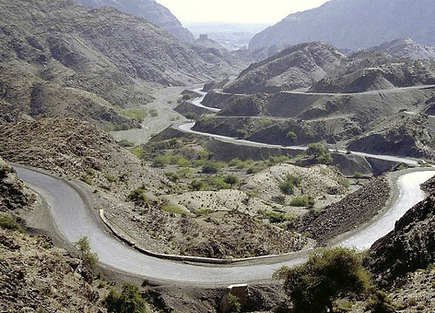

For a humble £145, the bus service also known as the ‘Hippie Route’ would travel from London through Belgium, Yugoslavia to Kolkata (formerly Calcutta) in India.
According to reports, the journey took about 50 days for the bus to reach Kolkata from London, spanning across 10,000 miles one way. The bus was an AEC Regal III model with ‘London to Calcutta’ displayed right across it that departed from London on April 15, 1957 and was driven by a man called Oswald-Joseph Garrow-Fisher. With the first service arriving in Calcutta on June 5, 50 days
later – the bus travelled from England to Belgium and then to India through Germany, Austria, Yugoslavia, Bulgaria, Turkey, Iran, Afghanistan, Pakistan and North Western India. The bus was better equipped than you think. Sleeping compartments, fans, music – there was more to keep the passengers comfortable during the long trip and in some cases passengers slept in hotels overnight or even camped if there was no other accommodation available.
After a good few years, the bus met with an accident and became unstable. It was later purchased by Andy Stewart, a British traveller who rebuilt it to be a ‘mobile home’ and double decker! Renamed as Albert, the double decker traveled from Sydney to London via India in 1968.
This bus route reached India via Iran and continued its journey to Singapore through Burma (now Myanmar), Thailand and Malaysia. The bus was then transported to Perth by ship from the ports of Singapore where it travelled to Sydney by road. With the same facilities as before, the charge for this bus service was £145 as well.

One of the most economic ways to tour South America's most scenic path. On a platform at the Tietê bus station in São Paulo, passengers were waiting with much expectation in their luggage. They would face thousands of kilometers of road on a bus route that proudly defines itself as “the longest in the world.” Six thousand kilometers separate Rio de Janeiro from Lima, Peru. The strategic stop in São Paulo is only one of the 30 of the itinerary, which takes five days and crosses landscapes that go from the fog in São Paulo to the green of the Amazon, passing through the Andes Mountains.
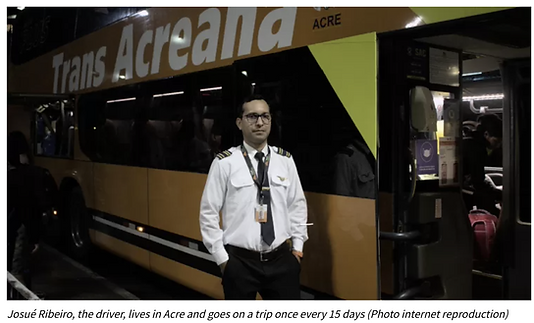
Transacreana, based in Rio Branco in the state of Acre, has been responsible since April for operating the stretch – which, in the past, entered into the Guinness Book of Records as the longest bus trip in the world. And Josué Ribeiro, 40, is one of those who takes command of the bus cabin. His experience could not be better for a trip full of surprises. A former nursing technician, he left the health area 16 years ago after making a living “piloting” ambulances. Now he alternates 15 days on the road with 15 days at home in Rio Branco.
Altitude sickness is one of the challenges of this trip, at Cusco, Peru, where the bus passes, is more than 3,300 meters above sea level, in the middle of the Peruvian Andes.The thin air, with less oxygen, causes unpleasant symptoms such as headache, nausea, difficulty breathing, and weakness.

The Federal Highway Administration of the United States calls it “the Mother Road”: others refer to it as the Main Street of America. Though no longer a major thoroughfare, Route 66 is still widely revered and remembered. Read about its history, or check out this video, then consider: what is the most famous road in your own country? Why do you think Route 66 still tugs at the imagination of travelers today?

People on road trips needed a place to sleep at night. Early on, many simply pulled off the road and camped beside their cars; over time, a new kind of car-friendly hotel emerged to serve them. Read about the world’s first motel and the history of motels since, then consider: are there equivalents in your country—and have you ever stayed at one?

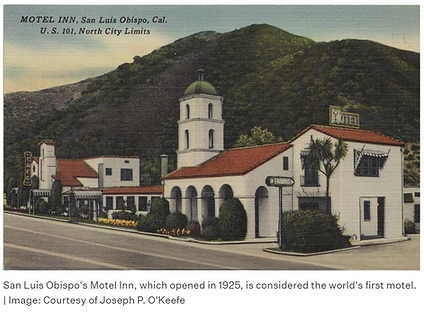
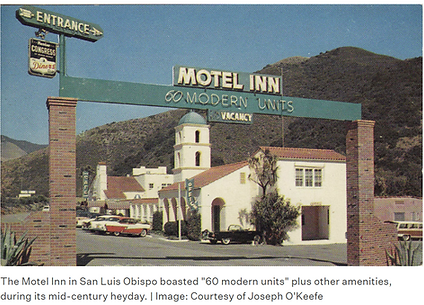

Roughly 90 years ago, San Luis Obispo saw the opening of the first motel in the world. The brainchild of Pasadena architect and inventor Arthur S. Heineman, the Milestone Mo-Tel — later renamed the Motel Inn — combined affordability and convenience with all the comforts of home.
Before the Motel Inn opened its doors on Dec. 12, 1925, lodging options for American motorists were limited. There were hotels, of course, but those could be expensive, fusty and far away from garages and roadways. Alternatively, travelers rented rooms in tourist homes, pitched tents at primitive auto camps or simply slept in their cars.
According to Heineman's great-grandson, San Diego digital marketer Norman McPhail, McPhail said his ancestor came up with the idea for the first “mo-tel” — Heineman coined the term by combining the words “motor” and “hotel” — while driving to and from the Bay Area, then a two-day journey. Heineman and his partners in the Milestone Interstate Corporation picked San Luis Obispo, located halfway between Los Angeles and San Francisco.
Unlike cheap motels we know today, the Milestone included many luxury amenities, including swimming pool, golf course and places for nice meals. Inside, the Milestone Interstate Corp. brochure promised, were “real home comforts,” including “restful beds with good springs and quality mattresses,” a “splendidly appointed kitchenette” and a “fully equipped bathroom” with showers and “running hot and cold water.” Other amenities included a service station, servants’ quarters and shared laundry and washrooms. Five of the cozy cottages even boasted attached garages.
“It was a stopping point for people,” he said, the site of countless first dates, honeymoons, family outings and anniversary trips. “They would come here and have lunch, or stay and make a day out of it.”
Developers John King and Rob Rossi purchased the Motel Inn for $3.6 million in 2000 and bulldozed most of the remaining structures in 2005, with the exception of the front office, which now serves as office space for Apple Farm employees, and the free-standing restaurant facade.
Now the Motel Inn property is getting a new lease on life. Together with San Luis Obispo development company CoVelop Inc., King and Rossi plan to build a 55-room hotel and recreational vehicle park. In addition to a 34,500-square-foot inn and 12 Mediterranean-style bungalows, the project. designed by local firm Studio Design Group Architects. will feature 10 Airstream trailers and RV spots. Other features include a restaurant, swimming pool and reflecting pool.
“It’s really trying to capture the feeling of what [the Motel Inn] used to be,” Rossi said of the project, recalling the original motel’s charm while conforming to modern standards for size, safety and comfort.

In light of California’s cultural associations with the automobile, it is no wonder that the roadside motel emerged in the twentieth century as one of the state’s iconic architectural types. The appearance of the motel as a common element in the American vernacular landscape dates to the 1920s. Motels were the product of a series of architectural adaptations beginning with auto camps, cabins, and cottage courts. What made these facilities so desirable to the earliest wave of auto tourists was the appeal of “convenience.” Motels offered several conveniences: the ability to park the car right outside the cottage door, more privacy, no streetcar or city traffic noise, no tipping, no traffic congestion when arriving at the accommodation, no dress codes because of the lack of formal public spaces, and a speedy check-out system. The growing affinity toward these types of motel qualities set the pace for the rise of an American roadside cultural icon.
By the 1950s, motor inns or motels often featured a U- or L-shaped layout around a center courtyard, where landscaping and sometimes swimming pools were meant to evoke a resort quality. These motels could accommodate up to five times more guests on the same amount of land than the earlier model of auto camps, and with their center-core layout with rooms on both sides along a corridor, construction and heating/cooling costs were cheaper. The average traveling American eventually preferred motels to downtown city hotels because of easy access and parking, a sense of individuality and no pressure to socialize with other travelers, and distance from the crowded, noisy urban center.
Consider the art and music selections below: what aspects of being on the road do they reflect? Do they over-idealize the experience of traveling by car—or critique it unfairly?
Nat Cole | “Get Your Kicks on Route 66” (1946)
“(Get Your Kicks on) Route 66” (1946)—popularized by Nat King Cole with the King Cole Trio—is a rhythm‑and‑blues classic written by Bobby Troup during a cross‑country drive. The song celebrates the romance of American road travel, turning the westward journey along U.S. Route 66 into a musical itinerary of cities, landscapes, and the freedom of the open highway. Bobby Troup wrote the song while driving from Pennsylvania to California in early 1946. He originally considered writing about U.S. 40, but his wife Cynthia suggested the catchier title “Get Your Kicks on Route 66.” Kicks here means having fun and suggests that driving was an adventure.
The lyrics include many geographical sites, including St. Louis → Joplin → Oklahoma City → Amarillo → Gallup → Flagstaff → Winona → Kingman → Barstow → San Bernardino. The lyrics instruct you to "get hip to this timely tip." Cole’s cool, smooth delivery embodied this "hipness," selling the idea of the road trip not as a dusty necessity, but as a stylish, jazzy journey.


Edward Hopper | Western Motel (1957)
Edward Hopper’s Western Motel (1957) is a late‑career oil painting that distills Hopper’s signature themes: transience, isolation, psychological tension, and the quiet unease of American travel culture. The work depicts a sun‑filled motel room, a lone woman seated on the edge of a neatly made bed, and a green Buick parked just outside the large picture window. It is a composite interior scene, synthesized from motels in El Paso, Texas, that Hopper visited, and the Rustic Canyon art colony in Los Angeles, where he held a six-month artist's residency. The work is currently held by the Yale University Art Gallery. Hopper's Western Motel, for example, serves as a very mundane twentieth-century descendant of Albert Bierstadt's nineteenth-century majestic views. It reinforces the fact that the West has been domesticated and is now framed by a picture window that is an extension of the same kind of opening found on 1950s suburban tract houses. Although the generic mountains are exotic, the motel room is familiar to any suburban dweller. The painting thus alludes to the fact that modern travel is often a collection of picture postcards and snapshots that lamely attempt to prove that one has gone outside the constraints of everyday life.
In July 1956, the Huntington Hartford Foundation awarded Hopper $1000 ($11,842 in 2025) and a six-month residence at their Rustic Canyon art colony near Pacific Palisades in California. Hopper was not a fan of California nor of art colonies, but after Jo discovered that people had nothing but good things to say about Rustic Canyon, she convinced Edward to go. They left their summer home on Cape Cod in October, with plans to drive a southwesterly route, presumably at some time in November. A Time magazine cover story on Hopper from December 1956, indicated that they drove a 1954 green and white Buick Century sedan to California, arriving in Los Angeles on December 9. Finding the lodgings comfortable and the food beyond reproach, they remained for the full six months. During their visit, they stayed in accommodations designed by Lloyd Wright, the son of Frank Lloyd Wright.
Edward Ruscha | Standard Station (1966)
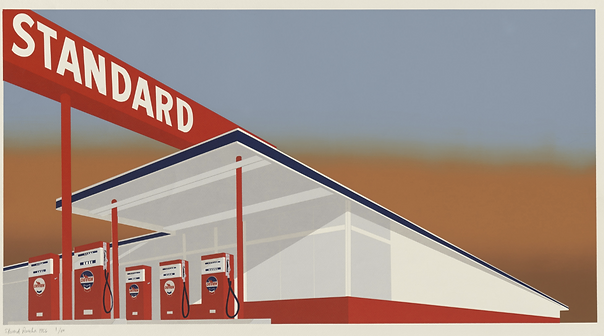
Edward Ruscha’s Standard Station (1966) is one of the most iconic images in American Pop Art—a bold, stylized screenprint that transforms an ordinary gas station into a monumental symbol of mid‑century U.S. car culture. The work distills Ruscha’s fascination with the American West, roadside architecture, and the visual language of commercial signage.
The origin of "Standard Station" lies in Ed Ruscha's personal experience of the open road. Born in Omaha and raised in Oklahoma City, Ruscha moved to Los Angeles in 1956 to study at the Chouinard Art Institute. His frequent drives along historic Route 66 between Los Angeles and his family's home in Oklahoma City became a formative influence. He began experimenting with the subject in his first artist's book, Twentysix Gasoline Stations (1963), which reproduces a series of banal photographs the artist took while driving on Route 66. Standard Station elevates a mundane gas station into a cultural totem of the American road. The dramatically foreshortened angle, the blazing gradient sky, and the oversized STANDARD sign turn a functional building into a symbol of mobility and freedom, postwar car culture, the homogenized American roadside, and the mythic promise of the West.
The gradient sky—orange at the horizon, deepening to blue—adds drama and heightens the sense of the American West as a place of cinematic light. It utilizes the "Split-Fountain" technique, a commercial printing method that blends different colored inks in the screen to create a "rainbow effect." Like many Ruscha works, the scene is depopulated. This emptiness emphasizes the vernacular architecture itself as the subject.
Edward Ruscha’s Standard Station (1966) exists in multiple, iconic versions, primarily as screenprints, exploring commercial imagery and color through variations like Mocha Standard, Double Standard, and Cheese Mold Standard with Olive (all 1969). These, along with the 1966 original, employ "split-fountain" techniques to create gradient skies.


.jpg)
Willie Nelson | “On the Road Again Song” (1980)
“On the Road Again” (1980) by Willie Nelson is widely recognized as one of the most iconic songs in American country music. Written for the film Honeysuckle Rose, the song expresses Nelson’s deep love for touring, music‑making, and the freedom of constant travel. It has become an enduring anthem of the nomadic, creative life. The repetition of the chorus (“just can’t wait to get on the road again”) functions like a mantra of joyful anticipation, capturing the exhilaration of touring.
Willie Hugh Nelson (born April 29, 1933) is an American singer, guitarist, songwriter, actor, and activist. He was one of the main figures of the outlaw country subgenre that developed in the late 1960s as a reaction to the conservative restrictions of the Nashville sound. In 1980, Nelson starred in
his first leading role in the Jerry Schatzberg film Honeysuckle Rose, about an aging musician and his relationship with his family, who also are part of his band that travels throughout the United States while playing in different venues. Shortly after signing the contract, Nelson was approached during a flight by Schatzberg and the executive producer of the movie, who requested him to write a song about life on the road to use as the theme song. Nelson quickly wrote the song on a barf bag.

David Hockney | Pearblossom Highway (1985)
Commissioned by Vanity Fair magazine, it is widely regarded as one of the most ambitious masterpieces of Hockney's photographic career, synthesizing his lifelong study of perspective, time, and cubist space. Pearblossom Highway transforms a mundane stretch of California’s Highway 138 into a vivid, multi‑perspective meditation on driving, seeing, and the American West. The piece was created from hundreds of individual photographs taken over several days and assembled into a monumental chromogenic collage.
With this piece of art, Hockney intended to portray a road trip through the desert, from the perspective of the person taking this journey, inside an unseen vehicle. He captured this perspective by showing the viewpoint of someone in the position of a car driving in the middle of the road. Hockney's collage effect created a choppy effect to the photograph, diminishing the smooth lines of an image. The choppy feel that the lines through the photograph creates allows the artist to convey a feeling that the image has been created by many people, all putting their photographs of this highway and their own journey together.
The light colours used in this piece make the mood untroubled, and gives a sense of light excitement. The lightness also suggest that this is image is set in the morning, at the beginning of a journey down this road, suggesting there is still more excitement to be had on this journey. The use of space means that the sky takes up almost half of the image. This portrays the wide open spaces on this highway. It presents the idea that a journey can take you anywhere, there is no confinement of the place that you can go. The way in which the sky takes up half the image also brings balance to the frame. The details—discarded cans, uneven asphalt, sun‑bleached signs—emphasize the mundane reality of roadside America. The result is a portrait of the American desert highway that is both documentary and psychologically expressive.
Tom Cochrane | “Life is a Highway” (1991)
“Life Is a Highway” (1991) by Tom Cochrane is an energetic heartland‑rock anthem that uses the metaphor of a highway to express life’s unpredictability, resilience, and the drive to keep moving forward. The song’s optimism is rooted in Cochrane’s real‑life experiences, especially a humanitarian trip to Africa that reshaped the unfinished demo into the global hit it became.
Cochrane originally wrote the song years earlier while with Red Rider, but he didn’t finish it until after a humanitarian trip to famine‑stricken regions of Africa. The suffering he witnessed left him shaken and searching for hope. The song frames life as a long, twisting road—fast, unpredictable, sometimes rough, but always worth traveling. Cochrane urges listeners to embrace the journey with courage and positivity, even when facing hardship. The chorus (“Life is a highway, I want to ride it all night long”) expresses a conscious choice to lean into life, not retreat from it. Companionship is central: life is better when shared with those “going my way.”


Bic Runga | “Drive” (1996)

Briolette Kah Bic Runga MNZM (born 13 January 1976), recording as Bic Runga, is a New Zealand singer-songwriter and multi-instrumentalist pop artist. Bic Runga’s “Drive” (1996) is a quiet, intimate song about longing, emotional escape, and the fragile, suspended moment of riding in someone’s car instead of going home. It’s the opening track of her debut album Drive and one of the earliest songs she ever wrote—famously composed just minutes before her first solo gig, when she needed more material for her set.
The speaker knows she “ought to go,” but she doesn’t want to be taken home—home represents endings, clarity, or consequences. Riding in the car becomes a temporary refuge, a place where she can feel “alive” again. The repeated instruction “you just drive” signals a wish to avoid difficult conversations and instead surrender to motion, sensation, and closeness.


Norah Jones | “Come Away with Me” (2002)
Norah Jones is an American singer-songwriter and musician. She has won several awards for her music and, as of 2023, has sold more than 53 million records worldwide. In 2002, Jones launched her solo music career with the release of Come Away with Me, which was a fusion of jazz with country, blues, folk and pop.
“Come Away with Me” is an intimate invitation to escape the noise of the world and retreat into a private, peaceful space with someone you love. The song is understood as a romantic getaway fantasy, blending simplicity, nature, and emotional vulnerability. The song is a whispered request for closeness—a desire to leave behind lies, pressures, and distractions and find refuge in shared intimacy. Jones imagines quiet, natural settings (cloudy days, yellow grass, mountaintops, rain on a tin roof) as the backdrop for a love that is gentle, honest, and enduring. Promises like “I’ll never stop loving you” frame the escape as not just temporary relief but a commitment to lasting affection. For Nora, driving is an escape and freedom to pursue love.
“Beware thoughts that come in the night,” writes Willian Least-Heat Moon, in the introduction to his 1982 road trip travelogue masterpiece, Blue Highways. Read the book’s first page here, then discuss with your team: do you agree with him that traveling in a circle has more purpose than traveling in a straight line? If you were given a car, unlimited gas (or endless EV charging), and all the time in the world, where would you want to drive it?

William Least Heat-Moon | Blue Highways: A Journey into America (1982)
Blue Highways by William Least Heat‑Moon (1982) is a landmark American travel memoir about a 13,000‑mile journey around the United States taken almost entirely on the small, overlooked backroads that appear as blue lines on old highway maps. The interstates (the "red highways") were designed for efficiency, allowing travelers to bypass the unique fabric of small-town America in favor of generic rest stops and fast-food chains. The blue highways, by contrast, were a route to authenticity.
It is both a literal road trip and a deep exploration of American identity, local history, and personal renewal. At its heart, Blue Highways is about a man at a personal crossroads. William, a 38-year-old college professor, lost his job due to declining student enrollment and separated from his wife. Lying awake, he had a pivotal realization: "A man who couldn't make things go right could at least go. He could quit trying to get out of the way of life. Chuck routine. Live the real jeopardy of circumstance". He sets out in a van he names Ghost Dancing to rediscover both the

country and himself. He avoids interstates and instead follows the “blue highways,” the rural routes that connect forgotten towns and overlooked communities.
Heat-Moon sought out conversations with waitresses, fishermen, hitchhikers, and eccentrics, creating a "gritty blue collar snapshot" of a nation moving away from its agrarian roots. In essence, Blue Highways endures because it taps into a universal longing: the desire to trade the fast lane for something more meaningful, to see what we've been missing, and to discover that the journey itself is often the destination.